To that end, state agencies, including the Uttar Pradesh Expressways Industrial Development Authority (UPEIDA), are drawing up plans to acquire land near key expressways and parcel it out to industry. Clusters focused on sectors like manufacturing and food processing are being proposed along these stretches.
It’s an approach that mirrors the government’s broader socio-economic strategy — boosting gross state domestic product (GSDP) by building infrastructure in the hinterland, and trying to close the gap between industrial growth and employment generation.
The expressway push has already brought visibility. The successful hosting of the Maha Kumbh in 2025, which drew an estimated 660 million visitors to Prayagraj over 45 days, was held up by the state as a demonstration of how improved surface transport can manage massive crowd movement. Officials also point to smoother freight logistics and a more connected tourism circuit.
There’s a technological spin too. With UP emerging as a key market for electric vehicles, expressways emerge as readymade platforms for charging infrastructure, if the state can match demand with grid capacity and investment.
But with the Assembly elections slated in 2027, the expressways are also a political project. The ruling Bharatiya Janata Party (BJP) is expected to showcase them -- along with new airport and tourism developments — as evidence of delivery and development in the face of Opposition criticism and incumbency fatigue.
The land footprint of these projects is substantial, often triggering spikes in local real estate prices and opening up employment in both construction and logistics. The government argues that by connecting rural belts to bigger markets, expressways are creating pathways for farmers, artisans and small manufacturers to scale up.
Mukesh Singh, chairman of the UP chapter of the Indo-American Chamber of Commerce, echoes the administration’s optimism. “The expressways facilitate faster movement of goods and people, connecting industrial hubs and agricultural zones. Travel time and transport costs go down. It becomes easier to access markets or commute to work,” he says.
Two major expressways — the 594-km Ganga Expressway (Meerut to Prayagraj) and the 91-km Gorakhpur Link — are nearing completion. Together, they entail over ₹42,000 crore in costs. Industrial corridors have been proposed along the Bundelkhand Expressway as well, particularly in Jalaun and Banda districts.
The UP government has also announced plans to interlink all the major expressways within the state to promote intra-state movement. A further ₹50,000 crore is being earmarked for seven new projects: Chitrakoot Link Expressway (15 km); Jhansi Link (100 km); Jewar Link (76 km); Vindhya Expressway (320 km); Vindhya–Purvanchal Link (100 km); Agra–Lucknow to Purvanchal Link (60 km); and Agra–Lucknow to Ganga Link (90 km).
Currently, four major expressways are operational: Yamuna (165 km); Agra–Lucknow (302 km); Purvanchal (340 km); and Bundelkhand (296 km), stretching across over two dozen districts.
Including the under-construction Ganga Expressway, the total length currently stands at 1,788 km. If all seven proposed routes are completed, the figure would rise to 2,563 km.
Other roads are also in the works under the National Highways Authority of India (NHAI), including the 63-km Lucknow–Kanpur Expressway and a 380-km Ghaziabad–Kanpur stretch. The infrastructure blitz has earned the state the moniker from Prime Minister Narendra Modi: Express Pradesh — a nod to both the pace and the scale of highway expansion.
Uttar Pradesh now accounts for nearly 45 per cent of India’s expressway length, with routes covering more than 40 of its 75 districts.
Expressways are helping industrialisation and agriculture through better connectivity, and they’re creating local jobs, says economist and social commentator Yashvir Tyagi, even as he cautions that the real challenge lies in turning this infrastructure into sustainable economic output over time.
Much will depend not just on the roads themselves, but what’s built around them.


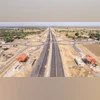 "The UP government hopes that connecting rural belts to bigger markets through expressways will create pathways for farmers, artisans, and small manufacturers to scale up. (Photo: uPeIda.uP.gov)")

