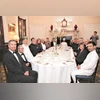
“It was a feast of memory, a taste of Mumbai recreated in the heart of London, reminding us that our traditions travel with us wherever we go,” Bilimoria told Business Standard. “Being at Mansion House that evening, I felt the weight of history. Going far beyond simply being another formal dinner, it was an affirmation of identity, a reminder of legacy, and a celebration of values that have sustained our people for millennia”.
Among those who attended were Cyrus Kapadia, CEO of Lazard UK; Ron Kalifa, who is instrumental in formulating Fintech strategies for the UK; Malcolm Deboo, president of Zoroastrian Trust Funds of Europe (ZTFE); and Zenobia Nadirshaw, professor and a leader in the field of mental health.
These were by no means the only Parsis in the UK. The first Parsi known to have arrived in Britain came as early as 1724. In 1861, Muncherjee Hormusji Cama and Dadabhai Naoroji founded the ZTFE, the oldest Asian association in Britain.
Three Indians have been members of the House of Commons — all three Parsis, including Shapurji Saklatvala, the first MP of colour elected on a Labour ticket in the British Parliament. Famed film-maker Christopher Mitchell has recorded his life in a documentary called Comrade Sak.
Parsis — as distinct from Zoroastrians or Iranians, who follow the religious teachings of Zarathustra and may have left Iran more recently, many running the famed Irani bakeries in Mumbai — number around 65,000 worldwide, 5,000-odd in the UK and some 50,000 in India. They are a model minority: They have consistently given to the country many times more than they have received.
“They have integrated into the interests and concerns of a country as it grew into a nation. They have contributed, catching the spirit of the nationalist movement, whether in the making of the Indian National Congress or during the first iteration of self-government. Among the earliest builders of the nation were the Tata and Petit families, leading to a crop of newer people of legacy like Cyrus Poonawalla, the maker of the Covid vaccine,” says civil liberties lawyer Maja Daruwala, the daughter of Field Marshal SHFJ Manekshaw – the man who led the Indian Army in the war that led to the creation of Bangladesh.
What is even more remarkable, Daruwala says, is that the Parsis created their identity without a language, without poetry, without a land, or a nation, and through a religion that does not proselytise.
“When a small group of refugees from a distant land arrived at Sanjan on the coast of Gujarat, the local ruler, Jadi Rana, was both suspicious and apprehensive,” says Rukshana Shroff, a Delhi-based Parsi and author of At Home in the Capital: The Parsis of Delhi.
“He asked for a bowl of milk to be brought. It was filled to the brim, indicating that just as there was no room for more milk, there was no room for newcomers in his land.
The leader of the group, in turn, asked for some sugar. He gently stirred the sugar into the milk, explaining that just as the sugar had dissolved into the milk, and enhanced its flavour, this group of asylum seekers would intermingle with the local population, becoming an integral part of society and sweeten its existence,” she narrates.
This story is part of Parsi oral history, and has played an important part in creating the Parsi self-image as well as other people’s perception of the community.
You cannot convert to a Parsi: You can only be born one, and that too, to two Parsi parents. This can create an obsession with purity.
But it is also self-limiting. “It is a dilemma,” concedes Daruwala. But many would argue it is more than that.
Unlike, say, the Hasidic Jews in New York, who guard their identity by aggressive external symbols like dress and appearance, becoming particularistic and turning into within themselves, the Parsis are a lot more relaxed, having embraced education or business to become of use to the societies they settle in, whether in India or abroad.
“Their numbers are so miniscule and their religion so obscure that they are unthreatening,” she says. At the same time, there is deep insecurity over dilution of the very traditions that define a Parsi.
Many Parsis confided to Business Standard that their religious identity could be mistaken because of their Islamic-sounding names, leading to some anxiety. But compromising on this would erode their existence as Parsis. “It is a quiet community, living small lives, without drawing attention to itself. To invite others into this life could put us in danger,” said one.
Others said they were appalled at how little the rest of India knows or understands the Parsis. The government’s move to enforce the Uniform Civil Code has met with ferocious pushback from the Parsis, especially on issues of inheritance and adoption.
Taken aback at the reaction of a community usually mild-mannered and tolerant, it has called for wider consultation.
Shernaz Cama, director of the Unesco-supported Parzor Foundation, is leading the efforts to make the Parsis of India better understood so that the nation, not just their own community, is invested in preserving their culture and heritage.
Parzor’s efforts were among those that led to Navroz being recognised as the international day of spring and being inscribed on the Unesco Intangible Cultural Heritage list in 2009. The Parzor Foundation runs an academic programme in collaboration with the Tata Institute of Social Sciences, called Culture and Civilisation: A Zoroastrian Perspective.
But the community is grimly conscious of the dilemma of survival it faces. The Jiyo Parsi programme, run in collaboration with the Ministry of Minority Affairs between 2013-14 and 2021, found that 30 per cent of eligible Parsis are single, and the fertility rate is only 0.8 children per couple. An average of 800 Parsis die annually compared to 300 births.
But even as they struggle, some things Parsis say and do are unique. Like their sense of humour. “Parsis don’t need therapy — they have lagan nu bhonu,” quipped one, guffawing.
Another observed: “A Parsi peg is the largest peg in the world! You may measure it by your palm – it extends over five fingers. The Patiala peg is also five fingers, but in the Patiala peg, the fingers are held together; in the Parsi peg, they are spread out.”


 "Parsi")