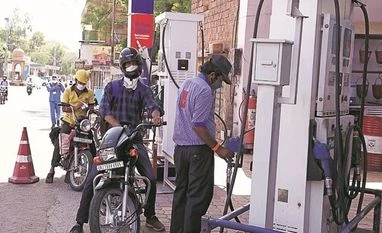
Last week, Reliance Industries (RIL) and bp Future Mobility’s joint venture, Reliance BP Mobility (RBML), launched its first Jio-bp branded Mobility Station (basically a fuel pump) at Navde, Navi Mumbai, Maharashtra. A statement from RIL said the existing network of over 1,400 fuel pumps will be rebranded as Jio-bp.
Number-wise, RBML is currently one of the smaller players in India’s fuel retailing ecosystem with just 1,419 outlets as of March 2021. Comparably, public sector undertaking (PSU) fuel retailers commanded 69,333 outlets (see chart: In the tank). But despite the smaller footprint, RIL-bp ends up cornering well over 10 per cent of the entire fuel sales in the country. Rosneft-owned Nayara, with more than four times the number of outlets, has a 6 per cent market share.
Explaining the reason for this variation, Y K Gawali, former director of marketing at Hindustan Petroleum Corporation (HPCL), said, “RIL had just 1,500 outlets when it began operations the first time. But they made a dent in the existing PSU players’ market share. In a span of one year, they captured 12-14 per cent of the auto fuel market.”
But that was the initial phase, when PSUs were not very alert or agile responding to the competition. Over a period of time, they too have learnt their lessons. The next turning point came after 2014 when diesel prices were deregulated. Although RIL struggled initially, it managed to get 10 to 12 per cent market share eventually.
“The number of outlets may not make a significant difference since the PSU outlets are spread out over rural areas. These rural outlets have sales of less than 30 kilolitres (kl) in a month, whereas the average throughput in a well-to-do outlet is around 170-180 kl a month,” Gawali said.
In other words, it is essentially location that makes a difference as far as the volume of sales is concerned. “Despite the higher numbers, PSU outlets are in far-flung areas. RIL-bp on the other hand goes for high-value outlets such as those on highways,” he added.
In fact, highways have become something of a focus area. “The urban market is already saturated, and RIL was never keen on opening outlets in cities. The focus will remain highway markets,” an RIL representative told Business Standard.
But merely fuelling up vehicles in strategically located outlets is only part of the plan. The Reliance-bp co-branded fuel outlets will be marketing their value-added auto fuel products as a strategy to attract high-volume consumers. According to RIL-bp, these new Jio-bp mobility stations will bring together a range of services for consumers — including fuels with additives (RIL is calling them additivised fuels), electric vehicle (EV) charging, refreshments and food. These outlets also plan to offer more low carbon solutions over time. In other words, RIL-bp pumps will focus on value-added fuels and high-volume consumers to grow market share.
“Instead of regular fuels, Jio-bp mobility stations across the country will offer additivised fuel, at no extra cost. The fuel offering will contain internationally developed ‘ACTIVE’ technology, which forms a protective layer on critical engine parts to help keep the engines clean,” the RIL statement said.
But RIL officials claim their product is of superior quality and is more beneficial for vehicles. These “superior” fuels will most likely be supplied from RIL’s refinery at Jamnagar, the world’s largest single refinery. “RIL has excess petroleum product output, and PSUs normally do not buy from RIL unless they are in a dire need or major shortage. So RIL will look for outlets to supply for their products where the RIL-bp venture will come in handy,” Gawali said.
Automotive fuel marketing is only part of the plan. Jio-bp will also set up a network of EV charging stations and battery swap stations, at its mobility stations and other standalone locations. The company’s statement said the joint venture aims to become a leading EV charging infrastructure player in India. This makes sense given the future of mobility.
“They may be looking at this aspect since petrol and diesel consumption is definitely expected to decline after a decade. Ola is aiming to produce 100,000 electric scooters in a year, according to Bhavish Aggarwal (CEO), and it has received a tremendous response. Once they start manufacturing and selling the two-wheelers, there will definitely be a dent in the sale of petrol,” Gawali said.
He added that charging technology from bp will be an added advantage for RIL’s existing stations.
Jio-bp will also be offering a network of Express Oil Change outlets, in partnership with Castrol, at its mobility stations. There will be free vehicle health check-up and free oil-change service through professionally trained experts. Every two-wheeler customer buying Castrol lubricant at the Express Oil Change outlets will be able to avail of the oil change service at no cost.

 "From conventional fuel to EVs, RIL-bp pumps up the mobility stakes")












 Connect with us on WhatsApp