5 min read Last Updated : Apr 07 2021 | 11:42 PM IST
In the chapter titled “The Obituary that Will Not be Written”, Neha Sinha writes about an elephant herd trying, repeatedly and unsuccessfully, to surpass a wall erected — illegally —on the fringes of the Kaziranga National Park in Assam to encircle a golf course. One photograph shows a young calf banging his head against the wall, trying to break it. Later, the calf was found dead next to the wall having suffered a haemorrhage. An educated guess indicates that he died in his attempt to break through. “When I read this,” writes Ms Sinha, “I unravelled.”
That’s the thing about Wild and Wilful; it flows from the heart. As significantly, though, it speaks the language of science and ethology in these evocative essays on 15 species, charting their place in an anthropocentric world.
An elephant, for instance, must navigate industrial parks and mines in what was originally their forests; the blind Gangetic river dolphin is mired in increasingly polluted, noisy waters and rosy starlings flying across continents on their annual migratory journey are confronted by the asphalt and concrete that is urban India. Even seemingly benign activities are cancerous — note the sprawl of wind and solar energy farms dotting the surrounds of Desert National Park, Rajasthan. The mesh of transmission wires that criss-cross this skyscape are deadly to the critically endangered great Indian bustard and other birds.
Ms Sinha is not shy about taking tough stands on policies that drive such impacts. Her eye is sharp and her spine steely as she comes down heavily on the National Waterways Act passed in 2017, which will dredge rivers to make them into busy highways for commercial ships. How, she wonders, will the blind dolphin, dependent on ultrasonic sound, survive in the cacophony of ships and mechanised boats?
Ms Sinha derides our warped view that marks animals such as snakes, crocodiles and leopards as dangerous “with an evil intent of killing people”. She beautifully portrays the agency, sentience and kinship of animals —like the mother elephant who climbed into a ditch, breaking her leg in the process, to save her calf who had fallen in. A wild animal “requires acceptance for what it is”. Instead, its very wildness is deemed undesirable; as in the case of a leopard who is lynched, beaten or burnt to death, simply because it exists and our perception of it being potentially dangerous.
Wild and Wilful: Tales of 15 Iconic Indian Species
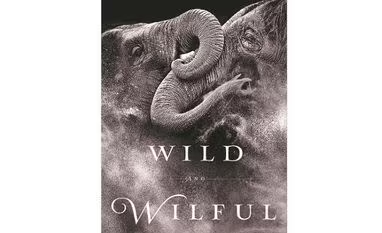
Author: Neha Sinha
Publisher: HarperCollins
Pages: 232; Price: Rs 599
In many ways, Wild and Wilful is a hard read, because the lived reality of wildlife is grim. “One of the penalties of an ecological education is that one lives alone in a world of wounds,” wrote naturalist Aldo Leopold in a Sand Country Almanac, “the damage inflicted is quite invisible to laymen.”
The reader is confronted with these invisible wounds, and it hurts because the stories are engagingly personal. The book also redraws our faulty maps for nature, where leopards survive in the millennium city of Gurugram and the maximum city of Mumbai and wild elephants cling to the fringes of cities such as Guwahati and Bhubaneswar among others. Tigers must live in broken fragments of forests sliced by highways, and the arid habitat of bustards irrevocably altered by the advent of a canal. In other words, it is the wild in the Anthropocene.
Ms Sinha’s book, however, rises above gloom and doom. It was extremely heartening, for instance, to read about the zealous protection of Amur Falcons in Nagaland by the same tribals who once slaughtered them by the thousands. If humanity’s actions are leading to ecocide; the saving grace are people whose lives are intricately linked to the wild. For the Gonds, a tribe native to central India, the tigress is revered as it once “birthed man”; in a remote village in Chhattisgarh a baba nurtures and protects crocodiles. More than the veneration, what shines through is the acceptance. When crocodiles are stranded, say, in a fallow land, farmers will lower their bullock cart, the crocodile will climb in; and climb out when the cart is lowered again at a suitable pond. Just picturing this scenario made me smile.
What also sparkles is the author’s sense of wonder. She hears bird song above the noisy cacophony of traffic jams and sees starlings and the brilliant flowers of semal in a city choked with smog and traffic.
Occasionally, the reader can feel crowded by detail. For example, in the chapter on the bustard, the author writes about the perilous fate of the Jerdon’s courser and the white-bellied heron. The urgency to highlight these imperilled birds is appreciated, but these details interrupt the narrative flow. A deft editing hand would have served well here.
That aside, there is no greater need today than to mend to our broken relationship with nature, to kindle our curiosity and love. Wild and Wilful will show the way. It is a must-read for our times.




