Publisher: Women Unlimited
Ms Sonalkar’s conversational writing style and vulnerability soften the blow. Her openness about her own life allows her to establish a sense of trust with her readers, making them more receptive to her arguments. For example, in her examination of the Hindu family, Ms Sonalkar critiques her own “overtly unhappy and dysfunctional family.” She talks about her father's affair with a woman named Mrs S that lasted till he died. Ms Sonalkar situates her father’s adultery and her mother’s decision to remain with her father as a product of a larger Hindu discourse. The Manusmiriti, a religious Hindu text, subjects the woman to the control of the male patriarch. It asks wives to obey the husband even if he is “destitute of virtue, or seeking pleasure elsewhere [.]” The Manusmiriti even contains caste-based rules for men who want to have more than one wife. Thus, for Ms Sonalkar it is the “hovering spirit of Manu” that allowed her father’s affair to remain an unspoken yet acceptable fact and shaped her mother’s decision to remain subject to the choices of her father. The biggest takeaway from the book, which makes it disturbing for the Hindu reader, is Ms Sonalkar’s conflation of Hindutva and Hinduism. She refutes the claim that “the Hindutva being propagated today by the ruling party and its followers is not the Hinduism [we] believe in.” She digs into what “the sacred texts of Hinduism have to say about war” and relates these teachings to the “war mania” being propagated by the Hindutva project against Muslims. For example, in the Bhagavad Gita, Krishna convinces Arjuna to go to war. Arjuna is taught to follow his “Kshatriya dharma” and kill even his relatives to perform his duty. The text states “killing one’s enemy is not a sin, because one kills only the body and not the soul.” The Hindutva project appeals to this religious sensibility and makes “attacking Muslims...a ‘religious’ act for Hindus.”

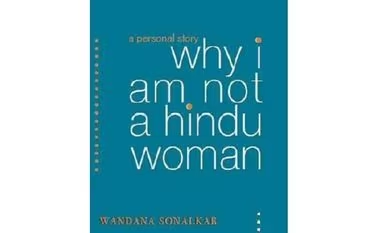 "A feminist renunciation")












 Connect with us on WhatsApp