5 min read Last Updated : Dec 24 2020 | 11:32 PM IST
Atal Bihari Vajpayee was prime minister of India over three stints: May, 1996 to June, 1996; March 1998 to October 1999; and October 1999, after the 13th general election, till 2004. In between he was leader of the opposition. Shakti Sinha, an IAS officer, served as private secretary to Vajpayee when in the opposition and then as joint secretary in the Vajpayee Prime Minister’s Office (PMO) between 1996 and 1999. This book limits itself largely to those years, though it does track Vajpayee’s early growth and development as a politician and a swayamsevak.
First, what the book doesn’t talk about. Another recent book by Vinay Sitapati speaks about the stresses, tensions but also joyous chemistry between Vajpayee and his colleague L K Advani. These tensions must have been present in the first two stints but Mr Sinha circumvents all that and says there are several premises in Mr Sitapati’s book with which he doesn’t agree: It would have been nice to know more about that relationship from someone who saw everything from close quarters. We know, for instance, that Mr Advani’s appointment as Deputy Prime Minister (although there’s no such thing in the Indian constitution) was the result of a serious power struggle between Brajesh Mishra and the troika of Mr Advani, George Fernandes and Jaswant Singh. While these tensions took on the proportions of a confrontation only in Vajpayee’s third stint, by which time Mr Sinha was no longer in the PMO, its roots must have been in earlier grievances and imagined slights.
Mr Sinha only briefly describes the tensions between Rashtrapati Bhavan and the PMO. President K R Narayanan was involved in trying to engineer an alternative government when the Vajpayee government fell in 1998. Reporters covering PMO at the time know how Narayanan manifested independent thinking on many occasions, especially during Bill Clinton’s visit in 2000 when he ridiculed, in his speech at the official banquet, the US President for describing India as the “most dangerous place on earth”. The PMO took an extremely dim view of Rashtrapati Bhavan’s attempts to strike attitudes.
But Mr Sinha’s book is valuable because it describes readably and factually, the other fault-lines in the government; and looking back, it is a wonder how the National Democratic Alliance governments survived and actually managed to get so much done. Jayalalithaa’s All India Anna Dravida Munnetra Kazhagam (AIADMK) sniped away at the government relentlessly through its 13 months. Other partners, too, sought their pound of flesh, secure in the belief that a government so critically dependent on their support would have to give in. This included the BJP’s extended family, the Rashtriya Swayamsevak Sangh (RSS) and its adjuncts, where the doughty Sangh stalwart Dattopant Thengadi never hid his opinion of some of the Vajpayee government’s economic policies, especially liberalisation of the insurance sector. The pressures ranged from the sublime to the ridiculous: The price of onions, combined with Madanlal Khurana’s blunt and open criticism of the RSS left Vajpayee with no option but to sack him.
Despite all this, Vajpayee steered the government through one set of nuclear tests, managing the fall-out adroitly, undertook a visit to Pakistan (and Mr Sinha’s account of the visit is masterly for its detail) and managed a war with Pakistan. In between, the government built roads, did some taxation, insurance and telecom reforms and won some but lost some elections.
Vajpayee: The Years That Changed India
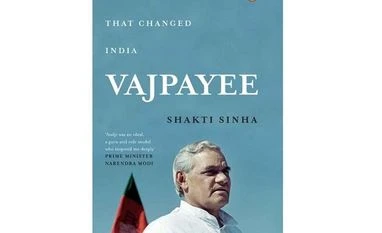
Author: Shakti Sinha
Publisher: Penguin
Pages: 357; Price: Rs 599
And Vajpayee never once blamed the opposition. For anything!
Of course, Mr Sinha’s appreciation of Grand International Strategy, Cold War, Hot War, yadda, yadda is important. But what makes the book a must read is the anecdotes he relates about the near misses. We learn, for instance, that as Vajpayee set off for Amritsar en route the Lahore bus ride, he checked his pockets and realised midway to the airport that he’d left his hearing aid behind. As cell phones were in use by then, Mr Sinha made a call to the house. “But while the PM’s motorcade gets a free pass on the roads, a car carrying the PM’s hearing aid does not,” he writes. Anyway, the hearing aid reached the PM on time and if anything was lost in translation in the dialogue between India and Pakistan it was not because of the Indian PM’s auditory nerve.
On a more serious note, the real turn of events in the Kargil war were represented by phone tape recording produced by Arvind Dave, the RAW chief, between Pakistan Army chief Pervez Musharraf, and his chief of general staff, Lt Gen Mohammad Aziz. The recordings made it clear that the Pakistan Army was involved in sending intruders across, with the Mujahideen playing a minor role, if any. This gave ballast to a full-on diplomatic offensive captured in the Blair House agreement between Bill Clinton and Nawaz Sharif in July, 1999.
Of course, there was a comic side to it that Mr Sinha captures with a metaphorical chuckle. That former editor of Patriot, R K Mishra was a backstage interlocutor with Pakistan’s Niaz Naik during the war, is well known. But Mishra was as paranoid as they come. So when he spotted an Ambassador car near his house in Vasant Vihar, parked for days on end, he pressed the panic button. The Delhi Police moved in and the car was towed away. However, when Mr Sinha got a call a few days later from an irate Shyamal Datta, then IB chief, all was revealed. The car was keeping watch on someone else and had been removed by Delhi Police on instruction from PMO. Datta wanted to know why. Ruffled feathers had to be smoothened.




