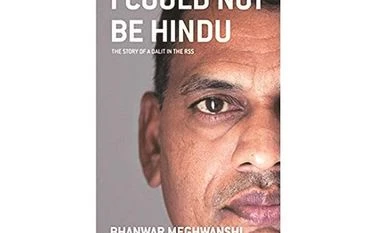
Bhanwar Meghwanshi’s I Could Not Be a Hindu: The Story of a Dalit in the RSS is an extraordinary memoir for these troubled times.
Beginning with a Dalit youth’s desire to prove his credentials as a “true swayamsevak ” during the Ram Janmabhoomi movement, it traces the journey of a brutal awakening to the intrinsic Brahminism of the Rashtriya Swayamsevak Sangh (RSS) and the author’s subsequent turn to Ambedkarite politics.
Mr Meghwanshi’s faith in the RSS received the first jolt when, as a 15-year-old, he travelled by train to Lucknow in October 1990 to participate in the “second battle of Independence”.
As soon as the train left the station, senior Sangh functionaries, pracharaks and industrialists got off. “Only people like me remained — impassioned Dalits, Adivasis, other young people from the lower castes, and a few sadhus and sants… some lower-order functionaries tried to put us at ease, don’t worry, these people have other contingents to see off and then they’ll follow us directly to Ayodhya. They were never to come. They were sensible people and went back to their homes. I understood that sensible people always use us, we who are driven by passion; they push us into battle and return to their safe little coops. In this lies their greatness; maybe greatness is just another word for cunning”.
This, however, didn’t precipitate a decisive break because the shakha had come to form an integral part of Mr Meghwanshi’s life, and he was impressed by the austere lives pracharaks led. Steady progress up the ranks, albeit at the local level, gave Mr Meghwanshi the impression that the Sangh valued him.
Things changed soon for Mr Meghwanshi, who had rebelled against his Congress-supporting father. He was denied the opportunity to be a pracharak because he was a vicharak (thinker) and the Sangh had no use for such people. It only needed those who could effectively convey the “message from Nagpur exactly as it was intended”.
Mr Meghwanshi’s decisive break with the Sangh came soon after. When he invited Sangh functionaries to his house for a meal after a funeral procession for slain karsevaks, he noticed their hesitation.
He was informed that the sadhu-sants who were part of the procession would be “really upset if without informing them, we give them food from a lower caste home”.
Mr Meghwanshi was asked to pack the food so that it could be used to feed the procession at the next village. The next day a good friend informed him that the food was thrown away right outside the village.
Thirsting for revenge, Mr Meghwanshi joined up with other disgruntled former swayamsevaks to form a students’ organisation to take on the Akhil Bharatiya Vidyarthi Parishad, the Sangh’s student wing.
Eventually, his quest to understand what he had witnessed led him to B R Ambedkar. He had, till then, read about Ambedkar in Sangh publications. “…I learnt that Babasaheb was a great nationalist... That he had wanted to make Sanskrit the national language and the saffron flag the national flag. That despite every temptation, he had not converted to Islam or Christianity but to Buddhism, which was part of Hinduism. And that he was opposed to the continuation of Article 370 in Kashmir, which gave the state a special status”.
What he read overwhelmed him, because it was exactly the opposite of what the Sangh had told him about Ambedkar. The texts helped him realise why of the six sarsanghchalaks, the topmost leaders of the RSS, five were Brahmins and one from a Kshatriya caste.
This opposition to the Sangh led him first to take up journalism and then to join hands with the Mazdoor Kisan Shakti Sangathan. And he hasn’t relented in his opposition to the RSS, despite periodic overtures from the Sangh. Being one of the few memoirs written by a former swayamsevak, the book repudiates the linear view of RSS mobilisation that even many of those who oppose the Sangh have come to accept.
Clearly, there are inherent fault lines in the RSS’s project of creating a homogenous Hindu society. These tensions remain despite moments when the project appears to have triumphed.
Consider the communal riots in Gujarat in 2002. Mr Meghwanshi says that during his travels across the state at that time, he realised that “much of the violence was committed by Dalits and Adivasis… The game plan of the right-wing forces was successful. Muslims, Adivasis and Dalits died fighting each other”.
It is, however, the realisation of the fragility of this project that drives the Sangh to seek to muzzle people like Mr Meghwanshi, whose relentless exposes of casteism in the RSS have resulted in multiple attempts to shut down his publications.
I Could Not Be a Hindu: The Story of a Dalit in the RSS

 "An RSS Dalit's awakening")












 Connect with us on WhatsApp