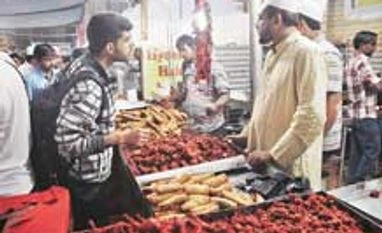
It's Friday evening, the day after the holy month of Ramzan began. Vehicles whizz down Mosque Road ferrying people to evening prayers at Hajee Sir Ismail Sait Mosque, after which they will break their 14-hour fast. But a group of us non-fasters has also gathered to make the most of the stalls churning out
kebabs and other delicacies that have sprung up on Mosque Road and MM Road. We are ably guided by the Bangalore chapter of INTACH (Indian National Trust for Art and Cultural Heritage), which had organised a Ramzan food walk.
Contrary to what one might think, the culture of erecting a multitude of stalls offering food on MM Road during Ramzan is just a few years old, says Mansoor Ali, architect by profession, foodie by choice and our guide for the evening. "Earlier, people used to frequent City Market, Johnson Market and Russell Market in Shivaji Nagar. Even the food we got those days was different - cut fruit and dates, which later graduated to
pakoras and samosas." Spartan, compared to what's on offer these days.
Though relatively new, we start off with a legendary name in the world of
haleem - the Mosque Road branch of Hyderabad's Pista House. The Hyderabadi Haleem made at Pista House has been conferred the GI (geographical indication) tag, we are told, since it is made with pure mutton, pure
ghee and cooked over a wood fire. Geographical indications are essentially names of places used to identify the origin, quality and reputation of a particular product.
Pista House lives up to its reputation and has gone from a single outlet selling 25 kg of
haleem a day 15 years ago to over 50 in Hyderabad and 20 in Bangalore. It also exports the delicacy. "It's made only during this season, mainly because of the labour involved - the mutton and lentils have to simmer for 12 hours before being pounded together with a mallet that's 5-feet long. And it's also too rich to have as a regular meal," Ali tells us while we wait hungrily for our samples. They arrive in deceptively small
katoris - the viscous mixture is topped with browned onion rings and a lemon quarter and seems pretty good to this haleem novice.
After a peak into the kitchen and an examination of the giant mallet, we cross the road to a place that prides itself on being unobtrusive. The owner, Ali says, actively shuns publicity and believes the food should speak for itself. Started in 1902, Albert Bakery was named after the prince to ensure that the British clientele was not turned away. It stays open for only three to four hours a day during which its range of snacks, from brain samosas to
sheermal, khoya naan and nankhatai are sold out. Fortunately, Ali had ordered our
khoya naan three days in advance and we dig into the small, soft, sweet slices. But we have to hurry out so that the men can make it to the mosque in time for
maghrib. While we wait, a few of us sample the
seekh kebabs at the stall closest to us - soft, but could have done with some more spice and seasoning. This year the number of stalls has come down by nearly half with the police restricting permission because of congestion and attendant traffic problems. Once the men join us after breaking their fast with dates from Medina, among other things, we whizz through one of the pandals, with Ali urging us to sample Chichaba's
biriyani from an outlet in Russell Market that's been around since 1935.
With prayers over, the roads are getting increasingly chaotic. Our last "official" stop is the restaurant Ali Baba that specialises in the cuisine of Bhatkal, a port town in Karnataka. The cuisine of the Navayaths (as the Muslim community there is known) is considered unique because of the influence of traders from West Asia, some of whom also settled down there and married local women. One of the specialties, which we try at Ali Baba, is
shaiya biriyani, made with vermicelli instead of rice, and chicken and spices. It's fairly mild and, interestingly for a
biriyani, quite light. We should save space for the mutton
biriyani from Richie's, Ali exhorts us, but it's too late, stomachs are already groaning.
A few of us wander down MM Road with Ali for a last glass of
hareesa, which is the milk version of
haleem, made with milk, almonds,
pista and poppy seeds. I have room only for a few sips. I would have to come again another evening, maybe this time after actually fasting. The baida roti (stuffed with
keema and then fried), Richie's
biriyani, pathar ka gosht and of course, the brain
samosas, all demand it.

 "Feast after the fast")


 Connect with us on WhatsApp