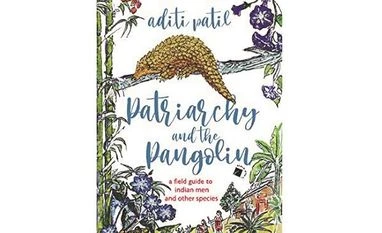
John Muir once said, “When one tugs at a single thing in nature, he finds it attached to the rest of the world.” As Aditi Patil tugs at nature, she finds it connected to a complex world shaped by gender norms, caste, and other unjust realities. Patriarchy and the Pangolin follows Ms Patil and her co-researcher Manya Singh into rural Gujarat as they attempt to discern the pros and cons of the National Agroforestry Policy, 2014.
As they research, they “run into life” and find that “the greatest threat to pangolins and imperilled species [are] Indian men and patriarchy.” Ms Patil utilises gender as a kaleidoscopic lens to exemplify that unequal gender relations characterise every aspect of life. Conservation research and even agroforestry are not exempt from this inequity. As Ms Patil ventures into Gujarat’s Anand district, the first stop in her expansive research project, she intends to interview “both men and women” working in the farms. Yet, she only gains access to a group of male farmers while the women remain relegated to the kitchen. Moreover, as Ms Patil conducts field research in Matar village of Kheda district, she discovers that women farmers were not only hard to interview but were also unwilling to answer questions, specifically those regarding gender roles.
Ms Patil even sheds light on common obstacles faced by female researchers. After losing funding for their research, Ms Patil and her co-researcher point out that the lack of funding makes women researchers more susceptible to urinary tract infections. They inform readers that “no funds meant dubious toilets, which meant possible infections, which meant stopping work, which meant no funds.”
Ms Patil’s insights into the world of conservation research do not merely end at gender. The significant advantage of the book lies in her firm grasp of intersectionality as praxis. She and Ms Singh refuse to study agroforestry in isolation “with [their] eyes shut to everything around the trees.” They emphasise the interconnected nature of everything, specifically oppressive institutions such as gender and caste.
Pages: 215; Price: Rs 291
As Ms Patil reflects on hard-hitting topics ranging from caste to limitations of research, the last thing the reader would expect is a laugh. But Patriarchy and the Pangolin is a book impossible to put down without laughing out loud.
Ms Patil utilises humour, specifically sarcasm, as a subversive tool to express dissent against a patriarchal society. For instance, when made to present her research in front of an all-male panel, Ms Patil trails off into a sarcastic monologue on what she truly wanted to say to the panelists. She refers to the board as a “patriarchal party” whose “evident diversity ... is heartwarming.”
What makes the book memorable, however, is the intimate and feminist bond between Ms Singh and Ms Patil. The entire “light-hearted and lightly heated tone” of the book stems from the “drama” created by Ms Singh in Ms Patil’s life. The two exchange banter but still find “warmth in each other’s company.” They take on every obstacle together, including “bureaucrats, forest guards, men with expansive mustaches, and other living species that are never as aggressive or threatening.” Their bond somehow makes being endangered by the ferocious Indian male species less taxing.
The lasting message for the reader is the need for such solidarity in this patriarchal society. Patriarchy and the Pangolin is a truly surprising book, as, despite its title, it is neither solely about the patriarchy nor the pangolin. They act as “symbols and threading leitmotifs” in a book that begins with conservation research but ends with insights into Indian society. It is a witty and nuanced book for anyone trying to navigate the complex, male-dominated jungle that is India.

 "Indian male in his habitat")












 Connect with us on WhatsApp