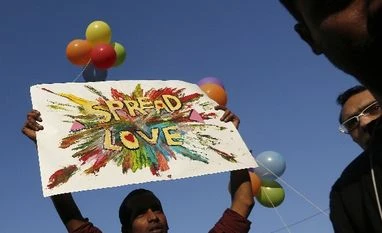
Hundreds of members of the LGBTQ community and their allies took to the streets in a strong show of support during the annual Delhi Queer Pride 2014 here in New Delhi on Sunday. The participants marched from Tolstoy Marg to Jantar Mantar in the heart of the capital. People danced to the beat of drums under a giant rainbow flag, the symbol of the global queer pride movement.
Many marched under a rainbow-balloon arch, decked up in rainbow-coloured wigs, tassels, face paint and masks. The parade was full of an electrifying energy, with chanting, sloganeering, slam poetry accompanied by smiles, love, song and dance. While queer pride marches in the West are generally held as apolitical gatherings of celebration, within India the Pride treads the fine line of celebrating diversity while asserting their fundamental rights.
Supporters of LGBTQ Community take part in the Delhi Queer pride march in New Delhi
It was the first pride parade in the city since the country’s top court reinstated Section 377 of India’s penal code in December 2013, which criminalises sex against the order of nature, widely interpreted as gay sex. The ball has been in the Parliament’s court since then, and chants of “Kaunsa kanoon sabse bhattar, teen sau sattatar teen sau sattatar!” rent the air on Sunday evening, urging the government to repeal the draconian law.
Other innovative posters and slogans included:
“Homophobia: Now that’s a choice!”
“Born straight, refuse to hate”
“Hindu Muslim Sikh Isai; Hetero Homo Bhai Bhai”
Supporters of LGBTQ Community take part in the Delhi Queer pride march in New Delhi
“Kyunki Baa Bhi Kabhi Feminist Thi!”
“Hum kya chahein? Azaadi”
“Different is not wrong”
“Gender aur Genitals mein farak hota hai”
While the majority of the attendees were people in their 20s and 30s, the incredible turnout for the movement saw supporters from all walks of life. Students of Tagore International School and Dora, a St. Bernard dog wearing a t-shirt promoting LGBTQ rights, were also among the crowds. Currently, the violation of the British colonial-era law is punishable with up to 10 years in jail.
A supporter of LGBT Community wearing mask of Britain's Queen Elizabeth II during the Delhi Queer pride march in New Delhi
A man with a Queen Elizabeth face mask carried a poster proclaiming “Out with 377 Antiquated British Law, Love Queenie”. One poster depicted Prime Minister Narendra Modi’s face filled in with rainbow colours along with the caption “I love Amit Shah,” referring to the president of the ruling party, generally considered conservative.
Many members of the queer community prefer hiding their sexuality for fear of discrimination, but the Pride parade has always one such event where everyone can reclaim public spaces without fear of bigotry. Shreya Ila Anasuya, one of the attendees at the parade, said that “I’m here because I don’t believe that human identities and experiences can be neatly categorised into boxes. We are diverse in many ways and we need to embrace and celebrate our diversity. It’s great to be here because Pride creates a physical space in the city, which is many times unsafe for women, queer and trans* people. But on Pride there is a physical space to come together as a large community and celebrate the different ways in which we experience our humanity.”
Supporters of LGBTQ Community during the Delhi Queer pride march in New Delhi
The march ended near Jantar Mantar, where many leaders of the movement as well as artists took to the stage to rally the crowd, express themselves and demand the repeal of 377. A performance art piece by Maya Krishna Rao and poetry readings by Akhil Katyal were the highlight and particular ire was reserved for yoga guru Baba Ramdev for his homophobic statements.
“The turnout this year’s Pride was almost double of last year,” said Praajak Chakraborty, a corporate communications specialist. “The colour and energy in this march always rejuvenates my spirit. This is a sign of acceptance, coming out in the open and making a statement -- loud and clear. When people gather, it represents collective public opinion in a big way. I’m hopeful that the law will eventually come in favour of the queers.” Over a thousand people attended the parade, no minuscule minority this.

 "Love is love: Hundreds march for Delhi Queer Pride 2014")


 Connect with us on WhatsApp