Massacre in a Bagh

Datta's book made it clear that the horror of the massacre shaped the making of Gandhi and the nationalist movement he led
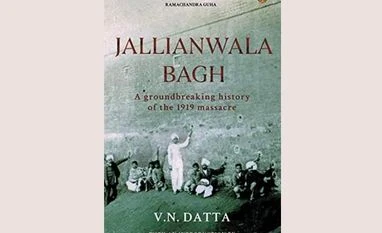
Book Cover
Jallianwala Bagh: A Groundbreaking History of the 1919 Massacre | Author: V N Datta | Publisher: Penguin | Pages: 256 | Price: Rs 399
Rudrangshu Mukherjee
5 min read Last Updated : Apr 26 2021 | 10:59 PM IST
It was April 13, 1919. Punjab, though in political turmoil, was celebrating the traditional New Year’s Day, Baisakhi. The day also marked the anniversary of the formation of the Khalsa by Guru Gobind Singh in 1699. As a part of the celebrations and also to make a political statement against British rule and its oppressive laws, a large number of people in Amritsar had gathered in an enclosed space called Jallianwala Bagh, which was a popular spot because it was close to the Golden Temple complex. Jallianwala Bagh measured approximately seven acres, about 200 yards long and nearly a square. It was an arid plot of land surrounded on all sides by high walls of houses and compounds. It had five small entrances, some of which had gates that led to narrow lanes. Near its centre was a large well about 20 feet in diameter and with water 20 feet below its parapet. Apart from a few trees, the space was bare. The walls surrounding it were nearly 10 feet high. Ingress and egress from Jallianwala Bagh were thus restricted and difficult at the best of times.

By the late afternoon on the fateful day, 20,000 to 25,000 people, including women and children, had gathered in Jallianwala Bagh. This was a quiet crowd, by no means an angry mob, and it was not apprehensive, though bewildered when a plane circled above them. A little after 4 p m, the crowd noticed soldiers, Gurkhas and Baluchis, enter the Bagh and take up positions barely 100 yards away; the fringes of the crowd were perhaps only nine or 10 yards away from the soldiers who were on a low rise at the western end. The presence of the troops caused alarm and many began to try and escape. At this point, the troops were ordered to open fire. The man who gave the order was Brigadier-General Reginald Dyer, commander of the troops at Amritsar. As whistles blew, the firing began.

It is not difficult to imagine the chaos that ensued but it is almost impossible to imagine the carnage that followed. There was a stampede towards the gates, which became jammed with people. The soldiers were ordered to directly shoot at those trying to flee; many died in the firing and many others were trodden underfoot or crushed under a mountain of corpses, 10 or 12 high. Those trying to scale the walls were easy targets. People, facing the prospect of no escape, huddled in groups in corners, and they were shot down. Some lay on the ground to avoid the bullets but they were shot where they lay. Dyer personally directed the firing, ordering his troops to fire where the crowd was thickest. Soldiers were either kneeling or lying down to pick off their targets. Even onlookers from the surrounding houses were shot at. The firing continued for 10 to 15 minutes. The sound of firing and of bullets ripping through human bodies was matched by the screams of people. The atmosphere was filled with dust, blood and pieces of flesh. Human beings ran around with their limbs shot through, eyes gouged out and their insides exposed before they fell dead. It was hell on earth.

Dyer stopped the firing only when he felt his troops had enough ammunition to defend themselves in case they were attacked during the march back. Dyer did not even cast an eye back on the massacre he had perpetrated. He showed the least concern for those who were alive but wounded. He gave orders to withdraw and walked back to his car. Thus ended the bloodiest episode in the history of British rule in India since the rebellion of 1857.

This description of the massacre, however brief, will be incomplete without highlighting some aspects that help to understand the scale and the significance of the violence. The most important of these is that Dyer’s decision to fire was pre-meditated. This is clear from Dyer’s own testimony. He was convinced that Punjab and the rest of India was in a state of open rebellion, and if British rule had to be preserved Indians needed to be taught an exemplary lesson. He was convinced that there was a conspiracy to isolate him and his force.

The above paragraphs are based on V N Datta’s path-breaking and pioneering book, which was first published in 1969 with the simple title Jallianwala Bagh. For most history students of my generation, Datta’s book was the only book that was available to learn about the massacre at Jallianwala Bagh. What is even more important is that the book has stood the test of time. Subsequent accounts have added little, both in terms of factual detail and analysis, to what Datta had written. Thus, this republication is welcome since the book is now retrieved from obscurity.

This new edition is enriched by a perceptive and informative introduction by Nonica Datta. There is one rather important point that she makes in her introduction. According to her, the events of 1919, as Datta analysed them, “cannot simply be characterized as a nationalist uprising…he [Datta] did not provide a hagiographic account of Jallianwala Bagh. For him, the victims of the massacre do not become martyrs. They were people who were let down by the nationalist leadership…he tries to place the crowd in the Bagh as being sandwiched in the clash between the larger imperial and nationalist forces”. Was the massacre, then, an event that was a fallout of a context and was later appropriated by first the Congress and then by nationalist historians? Datta’s book made it clear that the horror of the massacre shaped the making of Gandhi and the nationalist movement he led.
The reviewer is chancellor and professor of history, Ashoka University

One subscription. Two world-class reads.

Already subscribed? Log in

Subscribe to read the full story →
*Subscribe to Business Standard digital and get complimentary access to The New York Times

Smart Quarterly

₹900

3 Months

₹300/Month

SAVE 25%

Smart Essential

₹2,700

1 Year

₹225/Month

SAVE 46%
*Complimentary New York Times access for the 2nd year will be given after 12 months

Super Saver

₹3,900

2 Years

₹162/Month

Subscribe

Renews automatically, cancel anytime

Here’s what’s included in our digital subscription plans

Exclusive premium stories online

  • Over 30 premium stories daily, handpicked by our editors

Complimentary Access to The New York Times

  • News, Games, Cooking, Audio, Wirecutter & The Athletic

Business Standard Epaper

  • Digital replica of our daily newspaper — with options to read, save, and share

Curated Newsletters

  • Insights on markets, finance, politics, tech, and more delivered to your inbox

Market Analysis & Investment Insights

  • In-depth market analysis & insights with access to The Smart Investor

Archives

  • Repository of articles and publications dating back to 1997

Ad-free Reading

  • Uninterrupted reading experience with no advertisements

Seamless Access Across All Devices

  • Access Business Standard across devices — mobile, tablet, or PC, via web or app

Topics :BOOK REVIEWJallianwala BaghPunjab

Next Story



