It rained there yesterday,” was the sweetest sentence I heard on a scorching day in Delhi, from helpful Mr Ali at the Madhya Pradesh Tourism office. Less than a week later, a friend and I were on the road to Mandu from Indore, our spirits soaring as the verdant landscape grew hilly and the arched gateways of this achingly romantic medieval citadel in the Vindhyas came into view.
Mandu, with scores of monuments in pinkish-beige Dholpur stone, shimmering lakes and majestic trees strewn across 30 square kilometres, tells many stories. It speaks of shrewd military strategy, daring hillside escapes, rebellion and patricide, as well as its rulers’ love for warm baths in flower-shaped pools. It changed hands often over a millennium. But most of its restrained, beautifully proportioned palaces, pavilions, mosques and caravanserai came up during a 125-year period in the 15th and 16th centuries when satraps turned their backs on overlords in Delhi and called themselves the Sultans of Malwa. Perhaps they helped foster the ardent belief in Malwa’s uniqueness you encounter all the time here, with even kachori sellers in Indore’s Sarafa Bazar getting evangelical about its hawa (cool evening air), mitti (fertile volcanic soil) and khana (irresistibly tart street food).
Intertwined with all this are two captivating love stories — the poignant, much-told one of Mandu’s ill-fated poet-prince, Baz Bahadur, and his consort, Rupmati, and the euphoric one of Mandu and the monsoon. The Mughal emperor-aesthete Jahangir, who witnessed Mandu in monsoon bloom, was famously overcome by “the beauty of the grass and green flowers (that) clothe each hill and dale, each slope and plain”.
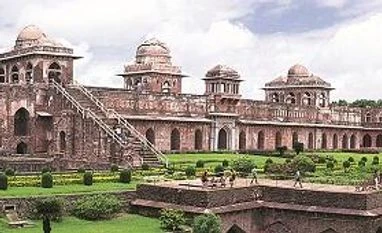
The Jahaz Mahal in Mandu
But monsoon-love can remain unrequited in early July, as we ruefully discovered when we ran into a host of amateur meteorologists. Waiters, guides, guards and shopkeepers squinted at cloudless skies, speculated madly about the prospect of fresh showers (two or three had fallen so far) and tantalised us with descriptions of swirling monsoon mists “that will make you lose your way in the streets”. We grew grumpier, as, dawdling inside thick-walled Jahaz Mahal to escape the steamy heat, we heard how the half-filled lakes on either side of this 120-metre-long pleasure palace of the Sultans brim over when the monsoons really take off, making it feel like a ship in tranquil waters. Our diligent guide, Javed, tortured us with descriptions of water travelling through spiralling water channels and hollow pillars into spouting fountains, wells and tanks, while recounting the extraordinary rainwater-harvesting techniques favoured by Mandu’s rulers (in an area that still faces acute water shortages).
In the monsoon, water travels through spiralling water channels and hollow pillars into spouting fountains, wells and tanks
Contentment, even enchantment, began to seep into us as we drove out early the next morning, taking in low, mud-walled huts in serene Bhil villages, black-and-white goats nipping at dewy grass and moss-covered medieval sentry-posts with branches and leaves growing riotously out of them. We ground to an excited halt every time we spotted a huge, bottle-trunked baobab tree — of African origin but believed to have come here via Iran. A refreshing breeze blew around us, whistling through arched corridors, as we climbed to the top of the elegant pavilion where Rupmati is said to have prayed to the Narmada. Every now and then, a light drizzle brushed our faces and raised our hopes.
Finally, it poured — but not in Mandu.
A pool at Jahaz Mahal
Cascading rain and fierce winds heralded our late-afternoon arrival in Maheshwar, after a winding hour-long drive into the Nimar plains. We were instantly swept up in the excitement of a low-key town revelling in a sudden change of tempo. The friendly waiters at MP Tourism’s Narmada Retreat happily chased flying tablecloths on a terrace with a mood-lifting view of a vast, silvery, heaving Narmada. Down below, on the ghats, a farmer, who grows cotton and maize in a nearby village, laughed away our alarm at his little grandson entering the river, explaining this was roz ki baat (an everyday affair).
Little Maheshwar, with a splendid fort named after an illustrious 18th-century ruler, Ahilyabai Holkar, and pretty stone temples, is not an A-list temple town. You feel profoundly grateful for that as you listen to a gentle, homespun evening aarti instead of the rockstar versions in Varanasi or Haridwar. Behind the towering fort walls are an upscale boutique hotel, old houses in sky blue and Jaipur pink, the whirring looms of Maheshwari sari-weavers and a charming café where you sip masala tea on the edge of a rain-drenched courtyard.
But even tranquil Maheshwar has its share of racy monsoon stories, with boatmen apt to boast about a swollen Narmada submerging villages and sweeping right up “here” — meaning, the steps where we are sitting. For now, however, the river is behaving, and those steps are the perfect place to lazily people-watch, and day-dream about revisiting Mandu in August to sail in a ship of stone.