The opening scenes of Gully Boy threaten to be yet another cinematic exploration of the Dharavi phenomenon. Film after film has fetishised the glorious Mumbai-slum life, where people win the world with nothing more than hearts of gold. Gully Boy is blissfully free of this cringe-inducing celebration of poverty. It questions the status quo every chance it gets, and it does so with dollops of humour.
Starring Ranveer Singh as Murad aka Gully Boy and Alia Bhatt as Safeena, Gully Boy, in spoiler-free terms, is a film about the rapping subculture in India. Loosely inspired by the lives of rappers DIVINE and Naezy, the film follows the lives of Gully Boy and his mentor, MC Sher, through emotional turmoil, financial hardship, broken families and the eventual rise to fame. In several ways, the trope of the film is predictable. When there’s a contest, you know Gully Boy will emerge victorious. When he makes a video, you’re expecting it to go viral. But despite that, the film employs nuanced storytelling that makes even the most ordinary subplots shine.
The first half is dedicated to Murad, Safeena and their firecracker of a love story. While Bhatt looks familiar in this role, Safeena’s character has been given so much chutzpah that it’s hard to find fault with Bhatt’s portrayal. Over the years, Bhatt has emerged as one of Bollywood’s leading actors and even in a film where she is not technically the protagonist, she sparkles. This also owes to Vijay Maurya’s quick-witted dialogues and writer Reema Kagti and director Zoya Akhtar’s crackling script. Safeena and Murad’s is a 21st-century love story, one that overcomes all social and financial odds with cheeky grins and expletives rather than drama and tears. For the smartphone and tablet generation, internet and music play cupid.
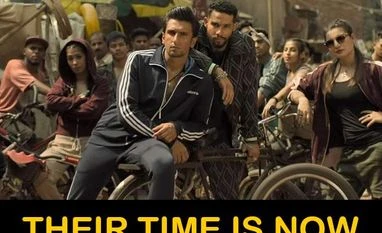
Singh as Murad is, of course, the star of the film. Akhtar’s direction has reshaped Singh’s patent flamboyance into a restrained portrayal of a starry-eyed young man from a troubled household. Singh brings a certain maturity to the screen, even though it appears a tad laboured in some scenes. The chemistry between Bhatt and Singh adds sufficient interest to the narrative, especially at a time when romance on the big screen has been feeling rather lukewarm.
Siddhant Chaturvedi as MC Sher is a true surprise. For a newcomer, he has remarkable screen presence, aided by a big booming voice. Amruta Subhash as Singh’s mother deserves special mention, too. Though she looks like a misfit in the role of Singh’s mother, Subhash holds her own even in the short scenes she has to herself.
Jay Oza’s cinematography complements Akhtar’s direction perfectly. A scene where Murad sits inside a snazzy car during his stint as a driver is shot with finesse. He sits in a black car under twinkling lights, a poet writing lyrics on his smartphone and declaring, “Apna time aayega (our time will come).”
The biggest strength of Gully Boy lies in the way it weaves personal stories and relationships into a narrative on the larger rapping universe. Thus, many rap sequences emerge from Murad and MC Sher’s own personal realities. Safeena’s equation with her parents makes for a few chuckles, especially in the realistic and unromanticised portrayal of a traditional Muslim household. Murad and MC Sher’s camaraderie is neatly written, too, where boys from the street celebrate each other’s successes rather than getting sucked into a vortex of jealousy.
Some relationships, like Murad’s with his friend Moin, start off real, messy and grounded but end up saccharine and unlikely. The same goes for Murad’s relationship with his father, which could have done without the too-neat conclusion at the end of the film.
Despite these minor quibbles, Gully Boy is a film for our times, encapsulated aptly and skilfully within the “roti, kapda, makaan plus internet” matrix.

 "Movie review: Zoya Akhtar's 'Gully Boy' is truly a film of our times")











