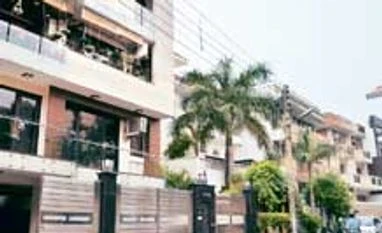
Real estate may be on fire elsewhere in the country, but for Rohit Minocha, who owns a brokerage firm called Inner Circle Project which deals exclusively in south Delhi houses, business is down. Builders here buy out old bungalows, demolish them, build three or four floors and sell them separately. Minocha complains that such builder floors are no longer in demand. "Defence Colony, which was always high on demand, now has 30 to 35 floors lying vacant," says he. "In Greater Kailash II, more than 20 - it could be 30 - flats have no takers, though these are being offered at prices lower than last year's. Many of these have had no buyers for the last five to six months." Depending on how desperate a builder is, a buyer can get a discount of 15 to 20 per cent on the asking price, says Minocha. "For big ticket properties, say something worth Rs 10 crore, a builder is willing to negotiate up to Rs 8.5 crore."
South Delhi, once the preferred abode of the rich and successful, is no longer a hot real estate market. "Property prices across south Delhi are down by 20-30 per cent in the last one-and-a-half years," says Samir Jasuja, CEO and founder of PropEquity, a real estate data analytics and research firm. He knows of a house in Vasant Vihar where the price tag has been slashed from Rs 23 crore to Rs 16 crore. "The market is certainly on the drop. I would say it's down by an average of 15 to 20 per cent," adds the proprietor of a company which has been in the real estate and construction business in south Delhi for 12 years. "There is fear among investors [builders and real estate firms] that it will fall further." Colonies like Defence Colony, Greater Kailash I, Vasant Vihar, Saket and Panchsheel Park have all seen a huge slide in value. "Nothing is selling in New Friends Colony. Inventory has really piled up," says Ashwani Singh Virk, proprietor of Jagson Realtors. "I have more than 50 houses waiting to be sold, but there are no buyers."
* * *
Several factors have contributed to the fall. South Delhi was preferred by corporate executives when their offices were at Nehru Place, Bhikaji Cama Place or even Connaught Place. In the last few years, companies have moved en masse to Gurgaon because south Delhi offices became too cramped. As the commute from south Delhi to Gurgaon can take over an hour (each way), many executives have chosen to relocate to the suburb. "With Terminal 3, the airport has become closer. And with the Metro link, the psychological barrier of distance from Delhi has been removed," says Vinayak Chatterjee, chairman and managing director of Feedback Infra. Four years ago, Chatterjee moved his office to Cyber City in Gurgaon after functioning out of Panchsheel Park for 19 years. He, of course, lives in Gurgaon. "Today, 60-65 per cent of all office spaces sold are in Gurgaon, about 30 per cent are in Noida and only about 5-7 per cent sell in Delhi (mainly Nehru Place, Saket, Connaught Place and Bhikaji Cama Place)," says Mudassir Zaidi, national director (residential), Knight Frank India.
Delhi's new farmhouse policy has also contributed to the fall in south Delhi prices. The Delhi Development Authority (DDA) recently reduced the minimum area needed for a farmhouse from 2.5 acres to 1 acre. This has made farmhouses available to a larger population and offered a much lucrative business opportunity to real estate firms. "Real estate firms and builders who used to buy property in south Delhi are now looking towards agricultural land," says Jasuja. Now, even neighbouring Haryana is finalising a policy for farmhouse colonies. These would be gated colonies of a cluster of 20-30 farmhouses of 1-2.5 acres each, complete with infrastructure like roads, water, power and security. DDA's new land pooling policy which allows private parties to plan and develop residential and commercial areas also has developers looking at projects away from south Delhi. "Not so long ago, every time a south Delhi property came into the market, 200 builders would line up for it," says Virk. "Not anymore."
Gurgaon, in contrast to south Delhi, offers a more affordable option. "Prices for both the commercial and residential properties in south Delhi are exorbitant. Residential property available in south Delhi comes at a premium of at least 50 per cent when compared with comparable properties in Gurgaon," says Santhosh Kumar, CEO (Operations), Jones Lang LaSalle. What has really worked in Gurgaon's favour is the huge primary market - new flats built by developers in gated communities. South Delhi is largely a secondary market because there is hardly any space left for building high-rises. A large chunk of the payment in the secondary market is in black; dealers say it can go up to 75 per cent of the price. And banks lend only against the amount paid in white. This has made many first-time buyers look at Gurgaon instead of south Delhi.
* * *
With steady demand, real estate prices in Gurgaon have escalated 206 per cent in the last five years (according to PropEquity). Still, south Delhi is far more expensive than Gurgaon. This has made some people sell their house here and move to a bigger one in Gurgaon. For 22 years, Niharika Malhota (name changed) lived in Shivalik, a locality of Malviya Nagar in south Delhi. About a year-and-a-half ago, when the Malhotas decided to move to a bigger and tonier address, south Delhi was their first - and at that time, only - choice. "We checked out a lot of areas; but each had its problems. In Greater Kailash and Saket, for example, parking and traffic were major issues. And New Friends Colony was way too expensive." After much scouting, the family gave up on south Delhi and turned to Gurgaon. "It made sense. My mother and brother both work at Pepsi which has offices in Gurgaon. My father is into real estate and he too has a lot of projects in Gurgaon," says Malhota. A year ago, the Malhotas sold their 3BHK Shivalik apartment and shifted to a 6BHK apartment in Gurgaon which came with a rooftop terrace.
Builders who had put their money in south Delhi are, of course, a worried lot.

 "South Delhi goes south")


 Connect with us on WhatsApp