Stepford Wives, Part II - The Factory
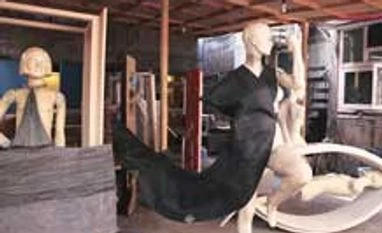
Kishore Singh New Delhi Imagine a factory of human limbs, of organs too gross to mention, of dismembered arms and legs and, indeed, decapitated heads, and you have some idea of what Vivan Sundaram has been up to. At Vadehra Art Gallery in the capital, the three floors of his current exhibition are like a mad scientist's - or serial killer's - clandestine warren. The installation that he describes as "violent, erotic, humorous" is, in fact, darkly chilling, a laboratory of the ugly and unfathomable. The splayed mannequins are like disturbing reminders of televised images of violence, a graphic novel as much of fury as of wretchedness.
To the lay public, Vivan Sundaram is better associated with his fortuitous DNA, the nephew of one of India's earliest modern painters, the irrepressible Amrita Sher-Gil, whose legacy has been bound indelibly with his own. Considered a significant painter himself at a time of the triumph of high modernism in the country, he is also one of its few intellectual faces, having run experiments and workshops in the Seventies and Eighties (inviting artists and critics to his and curator spouse Geeta Kapur's cottage in Kasauli) before giving it up to emerge among the rare modernists who crossed the bridge to embrace a more contemporary trope - not tepidly, as several of his peers have somewhat timidly done for the sake of form, but unhesitantly and completely.
In recent times, thus, his interest has been driven by societal issues, popular culture and the desire to be provocative, the latter not in a superfluous manner meant to draw attention to himself but with the serious intent of examining our reactions and relationships with the world around us. In making up a city of trash, he heightened our ability to grasp with serious concerns. Found objects turned into fashion for his Gakawaka take on fashion. The Kochi biennale had him visit a port of the past - Muziris - and invest his archaeological findings in a thought-provoking assemblage that brought together commerce and melting points on the global highways of ancient trade.
And yet, as an artist who has stayed largely outside the temptations of the market, his is a fascinating career. His aunt never quite enjoyed her success in her lifetime, drawing critical acclaim but not, alas, commercial success, the result, no doubt, of a tragically young life. But Sundaram seems to disdain the forces of the market, cocking a snook at popular practice that would have netted him a not insignificant fortune had he stuck to his promise as a painter instead of abandoning it to the tricky world of installations. In abjuring that lure of lucre, he has taken a position outside the ambit of the galleries that tend to view such eccentric behaviour as unworthy of their interest and support, the artist only as good as the sales at his previous outing.
In
POSTMORTEM (After Gakawaka), Sundaram has focused his - and our - attention on mannequins, a familiar sight with their androgynous faces and desexualised bodies, promiscuous models for a lascivious, image-hungry public who lap them up. The politics of fashion and anatomy come together in an adoration of limbs - a mass hypnotism of the sum of one's parts. Lights, shadows and sounds lend a dimension to the installations that emphasise the alienation of the individual, the atrophy of individuality. Using perverse humour, irony and a cruel wit, Sundaram jolts us yet again into thinking about the pervasion of an urban consciousness that eliminates the ability to think for oneself, a Stepford Wives redux that ought to be alarming. His confidence in steering his own direction allows him the freedom to cut that gash in a society where it bleeds not blood but a stream of banal consciousness.
Kishore Singh is a Delhi-based writer and art critic. These views are personal and do not reflect those of the organisation with which he is associated

 "Stepford Wives, Part II - The Factory")


 Connect with us on WhatsApp