There are still hidden corners in our populous and congested country which have escaped the relentless trudge of human feet, where ancient forests still luxuriate in dense clusters and clear night skies sparkle with myriad points of starlight. The Bara Bangal trek in Himachal threads through the Pir Panjal and Dhauladhar ranges tracing the annual migration of shepherds and their flocks from the high alpine pastures to the grassy valleys below as winter approaches. Come summer the return journey begins towards the now snow-free grazing grounds among the high mountains.
The trek kicks off in the town of Manali and concludes in the village of Bir above Dharamsala. Our group of four -- Ramya, Ashwin, Ranjit and I -- and a superb support team of nine led by guides Nitesh and Kirti covered a distance of 140km between September 22 and October 4 this year. This is a forbidding and treacherous landscape which only shepherds negotiate with rugged confidence; we encountered few other human beings. There were no settlements once we had entered the mountain zone, except for the utterly remote village of Bara Bangal, which has given its name to the trek. It lies midway between the two snow-covered passes of Kalahani to its east and Thamsar to its west, each over 4,800m high. One follows the Kalahani river up to Bara Bangal, from where the next section of the trail runs along the Ravi river. We stayed in tented camps but our guides made certain we were comfortable, well-looked after and fed from an unusually varied menu.
From Manali, the route led to Lamadugh, a gentle climb away over pleasant forest trails. The lush green patch on which we camped in cool and agreeable weather conveyed no hint of the strenuous effort and challenging risks which lay ahead of us. The next day we camped at Riyal Thach, at over 3,200m, after a longish trek of over seven hours. What made this journey memorable were the dense forests of golden oak, cedar and fir and the occasional maple tree with gnarled and twisted trunks but still supporting canopies of luxuriant foliage.
The author (second from right) with his fellow travellers
As we approached the tree line, stretches of densely packed snow fields began to appear, their thick, frozen edges hanging over swift and thundering streams. The next day on our way to the Kalahani base camp, we would begin making the first of several forays across these “snow bridges”, having to exercise extreme caution to avoid slipping and sliding helplessly over congealed ice. There were river crossings, too, which posed the constant danger of losing one’s balance and subjecting one’s feet to an unwelcome soak in freezing water. Walking thereafter with cold wet socks and dripping shoes was not a pleasant experience. At one such crossing a young porter lost his balance and plunged into the swift current rushing over rocks and boulders. As he went downstream, flailing among the rocks, we thought we had lost him. But he had good reflexes and managed to emerge with only a few bruises.
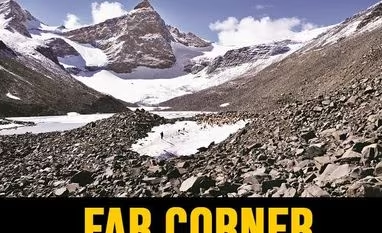
The climb over the Kalahani Pass and the extended descent to our camp at Donku Thach were physically exhausting and mentally exacting. Though we began the day’s trek earlier than usual, it took us considerable time to negotiate a difficult trail strewn with jagged rocks and slippery boulders. And then we hit a vast snow field stretching all the way to the pass, which from below appeared as a massive wall of ice blocking our passage. It was a slow and painful trudge through thick snow -- and a huge relief when we made it to the top of the Pass. But relief was short-lived as we still needed to descend over yet another vast stretch of ice on the other side, zigzagging to avoid slipping, before reaching a rocky flank over which lay our barely visible onward trail. This was forbidding country, with a series of small lakes and high mountains on the other side of the valley.
The next stretch to Bara Bangal village was a more gentle descent through a lush mountainscape interspersed with rolling meadows. We set up camp at Lampadh, at 3,550m and then at Dal ki Marhi, another 100m lower. There were no signs of human traffic except for the occasional “gaddi” or shepherd camping with his flock, taking shelter in covered shacks built with local stones. This was nature at its pristine best, unfolding serial vistas of rare beauty and gentle colours. But the final descent into Bara Bangal village was in pouring rain, our clothes wet and sticking to our skins, and our boots soaked through and caked with mud.
Red banners over the Thamsar Pass; three generations of a Bara Bangal family
There were two more stops, at Panihartu and Rajgundha villages, before we concluded our journey at the village of Bir. Rajgundha brought us back to human settlement, electricity, mobile signals and, inevitably, plastic waste. The entire village was celebrating some festival that night with loud music, drinking sessions and some impromptu dancing. Later that night we had a violent thunderstorm with relentless rain but fortunately it was dry though overcast the next morning.
The walk from Rajgundha to Bir is easy and pleasant along a wide track through lush green forests. Bir has become a popular centre for paragliding and it was crowded with fun-seekers when we walked though it towards our cars, waiting to drive us into Dharamsala.

 "The Bara Bangal trek in Himachal is very arduous and incredibly rewarding")











