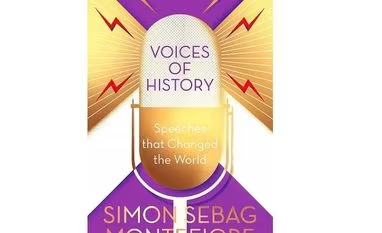
Several books on history’s “great” speeches have been published in recent years —The Chambers Book of Great Speeches, Lend Me Your Ears: Great Speeches in History edited by the late William Safire, an American presidential speechwriter, and The Penguin Book of Historic Speeches, to cite only three. The latest is by Simon Sebag Montefiore, a British television presenter, sometime war correspondent and author of popular history books.
The 78 speeches in Voices of History span two millennia, from ancient times to the 21st century, and are arranged into 19 subjects — resistance (to an enemy), dreamers, freedom, rise and fall, decency, battlefields, defiance, terror, trials, follies, power, peacemakers, revolution, warmongers, genocide, good vs evil, prophets, warnings and goodbyes. There is an overall introduction, and each speech is also prefaced by a short introduction by Mr Montefiore, in which he sets out the historical context of the speech, and explains why its stands out.
Words are powerful tools of communication, as great orators well know; they can sway people and mould public opinion. Mr Montefiore has included lofty, noble speeches couched in lyrical prose (Lincoln, Nehru, Kennedy, King, Mandela), as well as others full of hatred (Hitler, Heinrich Himmler, Josef Stalin, bin Laden). The power of language was brilliantly encapsulated by CBS reporter Edward Murrow during World War II, when he famously said of Churchill that he “mobilised the English language and sent it into battle”.
The speakers’ styles vary from the brief to the preposterously long. Lincoln’s Gettysburg Address was a mere 278 words long, while Churchill’s three speeches featured here are short and punchy. Britain’s war-time prime minister believed that subtlety was of little use in making a point; he preferred, in his own words, to “use a piledriver”. By contrast, Hitler’s speech in December 1941 announcing German dominance over all of Europe is the longest in the book. But both Churchill and Hitler were similar in one respect: They re-wrote and polished their speeches several times.
The strength of the book lies in Mr Montefiore’s masterful 12-page overall introduction, as well as in the explanatory introduction that precedes each speech. The brilliance of Churchill’s speeches lay in the care with which he wrote them, his mastery of the English language, and the manner in which he used his voice as a theatrical device. Nehru’s “tryst with destiny” speech is elegant, graceful and a superb piece of rhetoric. King’s “I have a dream” speech of August 1963, in which he advocates a more inclusive version of the white American Dream, is full of “evangelical cadences, Biblical references and spiritual echoes”. Mandela’s May 1994 speech pleads for national reconciliation in a nation torn by the black-white divide. The appeal of Kennedy’s inaugural address lay in its promise of a new dawn, and the idealism that underlay his exhortation to Americans to “ask not what your country can do for you; ask what you can do for your country”. Mr Montefiore describes President Trump as an unconventional but astute communicator, with a “discursive, bombastic, brazen” style that effectively expresses the anger of his support base.

 "The power of words")












 Connect with us on WhatsApp