Art in motion Mention travel photography and images of sweeping landscapes and local cultures come to mind. However, there are various other aspects to this genre that have lain unexplored. For instance, a “travel photograph” could be about capturing a community’s shift towards modernity or it could be a photographic statement about climate change through intimate portraits of people affected by it.
International outdoor photography festival, Travel Photo Jaipur, aims to do just that — “highlight that travel photography encapsulates various practices,” says Nikhil Padgaonkar, producer of the first edition of the festival.
For nearly 10 days, Jaipur’s landmarks — such as Hawa Mahal, Albert Hall Museum and Jawahar Kala Kendra — will serve as backdrops for 14 exhibitions from around the world. Many of these will be in the form of public art installations.
“We want to do away with the notion that photography is expensive or fragile,” says Padgaonkar. “So, we are printing on flex, a fairly inexpensive and rugged material. We have also ventured into the public sphere to dispel the notion of elitism around photography and photo festivals.”
A photograph by Rafal Milach from the In the Car with R series
So, there will be larger-than-life prints hanging from the ceilings of the train station and an abandoned art school being transformed into a site for an installation with postcards. People can approach these images on their own terms, unfettered by the pressure to view the images from the artist’s perspective. “They don’t have to enter a gallery, which can be intimidating for some. We also want to show that the heritage sites are not just about the past but are relevant to contemporary culture as well and can be reinterpreted in a contemporary context,” says Padgaonkar.
The first few days of the festival, which fall on a weekend, will be packed with screenings and talks by experts such as Giles Tillotson, former director of Royal Asiatic Society, London, photographers Waswo X Waswo and Cristina de Middel and Yumi Goto, co-founder of the Reminders Photography Stronghold.
The festival also includes two special interventions: a travelling photo studio by set designer and photographer Aradhana Seth and the conversion of the former Jaipur Art School in Kishanpole Bazar into a temporary exhibition space by photographer Akshay Mahajan. Mahajan will use vintage postcards from the colonial era to depict an age-old bond between travel and photography. These
postcards will be blown up into larger-than-life sizes and put up on courtyard walls for people to look at the images or read the messages.
“I am also playing with the architecture of the building, which is in old Jaipur style with window facades. Old ethnographic images will be juxtaposed against the windows,” says Mahajan.
Circus, from The Flying Houses series by Laurent Chehere
Vignettes from a journey
Fourteen photographers, including those from India, China, Nigeria, France, Mexico and Guatemala, will offer a glimpse into their journey.
Xiaoxiao Xu, who travelled to northwest China, a rough and unknown part of her country, for the first time in 2014, captures the atmosphere of alienation and mystery around “She Huo”, a centuries-old ritual that takes place around the Chinese New Year.
Especially striking are the photomontages that form part of the The Flying Houses series by Laurent Chehere. Inspired by a poetic vision of old Paris, Chehere has broken ordinary homes away from their urban context and transformed them into fantastical buildings, presented as aerial still life. “They testify, poetically, of the concerns of an impoverished class of society, particularly the gypsies and the immigrants,” says Chehere. “Released from the anonymity of the street, they talk about the dreams and hopes of its inhabitants.”
Chehere photographed hundreds of elements — roofs, windows, fireplaces, graffiti, sky — and then assembled everything on the computer. “I give some keys, but these flying houses remain open to interpretation. It is eventually the observer who will make his own way,” he says.
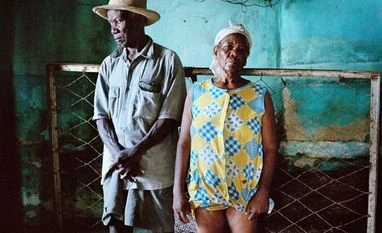
There are also evocative images by award-winning photographer Gideon Mendel of floods that ravaged the UK and India within weeks of each other in 2007. Mendel has spent nine years travelling the world, photographing floods. His Drowning World isn’t about submerged houses and people fleeing the flood. Instead, it presents intimate portraits of people and their condition, almost as if the subjects have sat for a conventional portrait. “Flood victims usually have a lot of anger — against fate and the authorities. They want to show the world what has happened to them,” says Mendel. This body of work earned him the 2015 Prix Pictet and has been hailed as one of the most eloquent photographic statements about climate change.
Travel Photo Jaipur will be on from February 5 to 14 across venues in Jaipur

 "Travel Photo Jaipur is all about change")


 Connect with us on WhatsApp