Two views on India's first woman prime minister Indira Gandhi

Sagarika Ghose's 'Indira: India's Most Powerful Prime Minister' has hit the stands
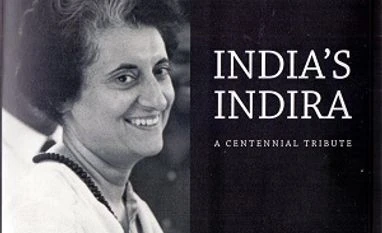
India’s Indira: A Centennial Tribute
Veenu Sandhu
Last Updated : Jul 14 2017 | 11:28 PM IST
Indira: India’s Most Powerful Prime Minister
Author: Sagarika Ghose
Publisher: Juggernaut 
Pages: 342
Price: Rs 699

This November 19, Indira Gandhi would have turned 100. Though seemingly down and out, the party she so emphatically formed around her cult is in celebratory mode. Ahead of her birth centenary, three books centred on her have been published already.

Also Read


First came India’s Indira, largely a puff job by the Indian National Congress (review below). Congress leader Jairam Ramesh’s Indira Gandhi: A Life in Nature followed soon after, drawing attention to Indira, the environmentalist. And now, journalist Sagarika Ghose’s Indira: India’s Most Powerful Prime Minister has hit the stands.

Ghose’s publisher has declared on the book jacket rather presumptuously that “this is the only book you need to read about Indira Gandhi”. One wonders whether they are forgetting one of the finest books on her has already been written: Katherine Frank’s Indira: The Life of Indira Nehru Gandhi, a thoroughly researched tome that was first published 16 years ago after six years of extensive work.

So what more could Ghose offer? A fair bit, it turns out, when you read “The Great Dictator”, a chapter that stretches over almost 70 pages and which alone is reason enough to pick up this book.

Drawing from all possible sources, Ghose puts together Indira’s life, the events of which would transform this once frail, uncertain woman into the most formidable politician India has seen. It was her 15 years as prime minister, in two stints, that created the cult of personality-driven politics, the full force of which we are feeling today. It is from her that present-day political stalwarts continue to draw lessons on testing the limits of constitutional democracy, and whose slogans even her party’s staunchest opponents imitate even after over 30 years of her death.

Examples:

“Woh kehte hain Indira hatao; main kehti hoon garibi hatao (They say remove Indira, I say remove poverty)."

“Woh kehte hain Modi hatao, mein kehta hoon kala dhan hatao, bhrashtachar hatao (They say remove Modi, I say remove corruption, remove black money).”

A sizeable chunk of India’s current population was born after Indira Gandhi’s death. Few of them know what India was like under her. But the ones who do, remember it only too well. Through Indira, Ghose does well to jostle our memory and take us to the past to show us the future we could well be staring at one more time in history.

Ghose turns the spotlight on the master tactician who had only India’s interest in mind but who paradoxically also came to believe that she and only she could be trusted to safeguard that interest by keeping a tight hold on the reins of power. So much so that, as Ghose writes, on the eve of declaring the Emergency, Indira said to West Bengal Chief Minister Siddhartha Shankar Ray, “I feel that India is like a baby and just as one would sometimes take a child and shake it, I feel we have to shake India.”

At the pinnacle of power after the decisive 1971 war that would liberate Bangladesh, the leader who could have, given the mandate she enjoyed, channelled the hope and optimism of the country into creating a new kind of politics, became a victim of her political insecurities.

There is a sense of here and now in Ghose’s writing as she talks about how Indira tried to compromise robust institutions that are essential for a healthy democracy and reduce them into appendages of the prime minister’s office. Banks, courts, the press, fundamental rights were all grist for her brand of authoritarianism before the judiciary stepped in and “saved Indian democracy”.

Here was a leader who could no longer tolerate dissent, who would come to view opposition not as a necessity in a democracy but as a conspiracy against her that needed to be actively discouraged. It is a familiar narrative that many believe is being replayed. This makes Ghose’s book all the more relevant.

In her book, Ghose draws insightful parallels between Indira and her father, Jawaharlal Nehru, to whose expectations she constantly tried to live up but against whom she would also rebel to marry Feroze Gandhi.

“Nehru, the disciplined Congress soldier, regarded the party as bigger than himself,” Ghose writes, “But Indira Gandhi had created… a Congress reliant entirely on herself.”

“She (Indira) was comforted by the mediocre and threatened by exceptional talent,” goes another line. “Nehru remained unthreatened by accomplishment in and disagreement from others.”

The sections in which Ghose deals with Indira’s relationship with her maverick younger son, Sanjay Gandhi, said to be the one who encouraged her to impose the Emergency, vividly bring out the desperation of the mother that stands in sharp contrast to her otherwise powerful image. The author puts the picture in your face as she writes: “Indira Gandhi failed both as a mother and prime minister when she made available the prime minister’s office as a plaything for her child.”

She also draws attention to the menace of dubious political funding, the roots of which, too, lie in Indira’s insecurities. In 1969, Indira banned corporate donations to political parties fearing that companies would donate only to the right-wing Swatantra Party. With legal contributions banned, underhand deals were struck between politicians and industrialists.

One jarring issue in the book are the “letters” Ghose has written to, as she says, the “ghost of Indira”. These are questions, she feels, any citizen might want to ask of the former prime minister. But all that these letters do is interrupt the otherwise smooth narrative.

There is one letter, though, that catches attention for a crucial point it makes as it quotes from one of Nehru’s letters to his chief ministers where he writes: “We must remember that what our governments are doing today will set the tone for future administrations. The very powers that may be exercised, perhaps for adequate reasons today, may be exercised later for totally inadequate and perhaps even for objectionable reasons. It is always unsafe to weaken on principle.”

If only Indira had stayed that course, her legacy might have been more endearing — and enduring.
The reviewer is co-author of Rahul, a political biography of Rahul Gandhi  
 

Indira: Alternative facts


India’s Indira: A Centennial Tribute
Editor: Anand Sharma
Publisher: Academic Foundation 
Pages: 299
Price: Rs 3,500


When the title of a book reads “a centennial tribute”, you know what to expect. Brought out by the Indian National Congress to commemorate Indira Gandhi's birth centenary, India’s Indira conveniently glosses over her every controversial decision and action, including the Emergency.


In fact, it tries to turn history on its head. In the first section of this poorly edited coffee-table book, its editor, Congress leader Anand Sharma, paints Indira as a victim who was “compelled to impose emergency” to arrest a Jayaprakash Narayan-driven anarchist, anti-Indira movement to “preserve democracy and the Constitution”. He then goes on to project her as a great democrat for lifting the Emergency. 


Sanjay Gandhi and his steely hold over his mother, too, find little mention. He appears in only two sentences as the son who died in an air crash and whose loss left her devastated.


Section Two, featuring Indira’s selected speeches, is more readable, particularly her speech on communalism at the Institute of Democracy and Socialism in 1970. “What can be more easy in a country like India than to rouse people emotionally with slogans of religion, with slogans of language and with other regional interests?” she says. Nearly five decades later, the reality of that question remains as worrying.


Section Three, which includes accounts of diplomats, world leaders and a filmmaker, is the most interesting. Former Sri Lankan president, Chandrika Bandaranaike Kumaratunga, remembers her last meeting with Indira in 1977, soon after her defeat in the Lok Sabha elections. Indira had been asked to leave the prime minister’s official residence and having donated the family home, Anand Bhawan in Allahabad, to the state for a museum, she told Kumaratunga she didn’t know where she would now live.


Similarly, filmmaker Shyam Benegal talks of the time the censor board banned his film Nishant. He managed to get it screened before Indira who was then the information and broadcasting minister. After the screening, all she asked was why the film had been banned. She felt denying it a censor certificate would make the government seem insensitive and petty, Benegal recalls. That, from a leader who would later impose censorship of the worst kind on the nation. 
Veenu Sandhu


One subscription. Two world-class reads.

Already subscribed? Log in

Subscribe to read the full story →
*Subscribe to Business Standard digital and get complimentary access to The New York Times

Smart Quarterly

₹900

3 Months

₹300/Month

SAVE 25%

Smart Essential

₹2,700

1 Year

₹225/Month

SAVE 46%
*Complimentary New York Times access for the 2nd year will be given after 12 months

Super Saver

₹3,900

2 Years

₹162/Month

Subscribe

Renews automatically, cancel anytime

Here’s what’s included in our digital subscription plans

Exclusive premium stories online

  • Over 30 premium stories daily, handpicked by our editors

Complimentary Access to The New York Times

  • News, Games, Cooking, Audio, Wirecutter & The Athletic

Business Standard Epaper

  • Digital replica of our daily newspaper — with options to read, save, and share

Curated Newsletters

  • Insights on markets, finance, politics, tech, and more delivered to your inbox

Market Analysis & Investment Insights

  • In-depth market analysis & insights with access to The Smart Investor

Archives

  • Repository of articles and publications dating back to 1997

Ad-free Reading

  • Uninterrupted reading experience with no advertisements

Seamless Access Across All Devices

  • Access Business Standard across devices — mobile, tablet, or PC, via web or app

Next Story



