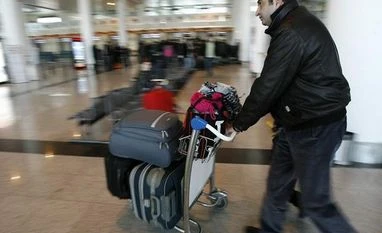
Mind the weight of your luggage the next time you fly. Carrying a few extra kilograms in airlines will become costlier as airlines in India have hiked their fees for excess weight.
Starting today, IndiGo, Go Air and SpiceJet have hiked the charge for luggage to Rs 400 per kg for anything beyond 15 kg from existing Rs 300 per kg. The hikes, which were simultaneously put into effect by the three airlines, were accompanied with IndiGo and SpiceJet increasing their pricing for pre-booked excess luggage by around 33 per cent.
Charges for pre-booking 5 kg, 10 kg, 15 kg and 30 kg beyond the permitted 15 kg on IndiGo's domestic routes will now be Rs 1,900; Rs 3,800; Rs 5,700 and Rs 11,400, an increase of almost Rs 3,000 from existing rate in all categories.
The hike is uniform for SpiceJet flyers with charges by around 12 per cent at Rs 1,600, Rs 3,200, Rs 4,800, Rs 6,400 and Rs 9,600 for 5 kg, 10 kg, 15 kg, 20 kg, 30 kg respectively. These charges earlier used to be Rs 1,425, Rs 2,850, Rs 4,275, Rs 5,700 and Rs 8,000.
DGCA regulations make it mandatory for airlines to permit 15 kg free check-in luggage on domestic routes.
Airline executives called the hike a sound pricing policy, saying that it is an alternative means of earning some revenue, after the failure to raise ticket prices despite the increase in operating cost due to surging fuel prices.
“Airlines need to earn revenue from ancillary sources when fares are not increasing, as this will somewhat mitigate the losses and allow airlines to offer attractive base fares to flyers,” one executive said.
Ancillary revenue refers to the earning from non-ticketing resources and for low-cost airlines these include excess luggage fees, on-board sale of food and beverages, cancellation fees etc. For IndiGo, this revenue stream rose 13 per cent in FY17.
Industry experts suggests that increasing fees for baggage is also an airline’s way of discouraging passengers from carrying more weight, as a lighter load would mean less fuel burn for planes.
Full-service carriers are also changing their strategy to earn more ancillary revenue. Sources suggested that Singapore Airlines affiliate Vistara is toying with the idea of a seat-only fare scheme, where passengers will have to pay for luggage, food and a higher cancellation fee as compared to normal tickets.
“Baggage fees play a similar role to “pay as you go” utilisation charges in cell phone plans: they lead different types of customers to self-sort into the pricing structure that fits them best. This self-sorting, in turn, allows the airline to more profitably serve different types of customers,” said an executive of a travel agency.
A high fuel price environment and a weaker rupee have thrown a challenge to airlines, as increasing fares has becomedifficult. While fares have largely remained flat, the price of jet fuel has risen 22 per cent and the rupee has depreciated six per cent since January. A moderate 5-6 per cent fare hike in mid-May resulted in a decline of growth rate in passenger numbers, leading to sector analysts questioning the ability to increase fare where low fares have been the primary reason behind a high growth in flyer numbers.

 "Airlines couldn't hit you with fare hikes, so they've raised luggage fees")











