RCom gets 7-month breather from banks

Anil Ambani tells investors the firm will get back in shape
graph
graph
Dev Chatterjee Mumbai
Last Updated : Jun 03 2017 | 2:07 AM IST
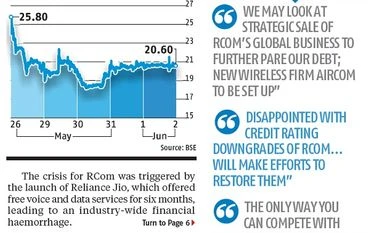
Lenders have decided to give Reliance Communications (RCom) time till December to make interest and principal repayment so that the company could sell assets and reduce debt, even as they took the strategic debt restructuring (SDR) route for the Anil Ambani group-owned firm. 

“We are undertaking two transactions to sell our assets, which would be the largest-ever debt reduction by any Indian company,” Reliance Group Chairman Anil Ambani said here on Friday. 

The company has decided to hive off its wireless telephony business, which would be merged with Aircel and help reduce debt by Rs 14,000 crore, Ambani said. The new company would be named Aircom. 

RCom will also be selling a majority stake in its telecom tower business to private equity fund Brookfield for Rs 11,000 crore and hold an economic interest of 49 per cent. “We plan to complete both transactions by September this year and we will be out of the SDR much before the December deadline,” Ambani said.

In a meeting of the Joint Lenders’ Forum, the banks opted to use SDR on the RCom account, which would help treat the loans as a standard asset for 18 months. This would in turn help lenders from making huge provisions for weak or stressed assets. Banks, however, need to set aside more amounts for standard asset provision than in the normal course. 

RCom had a total debt of Rs 45,733 crore as of March this year and has defaulted on payments to a few lenders. A few banks had treated the account as a special mention account. 

Apart from the two transactions, Ambani indicated that the company would look to sell a stake in its overseas undersea cable company, Global Cloud Xchange (GCX), and land in Navi Mumbai and New Delhi, without giving any indication of its valuation.

The crisis for RCom was triggered by the launch of Reliance Jio, which offered free voice and data services for six months, leading to an industry-wide financial haemorrhage.

“The only way you can compete with a free service is by offering a free service,” Ambani said and added the entire industry’s financial metrics had deteriorated due to competition, high spectrum fees and high debt.  RCom will also present its sustainable long-term plans for servicing the remaining debt of Rs 20,000 crore to the lenders. 

In the event, the transactions are not completed in the above timeframe, the lenders may exercise their right to convert their debt, in accordance with applicable SDR guidelines. The scheme is subject to lenders’ formal approvals and all other approvals as may be necessary under law, RCom stated. Ambani said the company was current in all bond payments and assured investors that the company would once again retain its lost glory. “I assure all investors that once our debt restructuring is over, the company will get back into shape,” Ambani said. Since the company announced its financial results for fiscal 2017 last Saturday, its shares have lost 20 per cent of its value — making shareholders jittery. 

Ambani said many of the unfortunate events related to the company were due to external factors. “Our merger with SSTL was delayed for nine months only because of one shareholder who owned 10 shares in the company which was not even worth Rs 1,000,” Ambani said. 

The Aircel transaction also hinges on a Supreme Court case in which Aircel promoter Ananda Krishnan failed to appear before the court, leading to delays in the case. The industry metrics are falling with return on capital coming down to as low as 2 per cent which is below fixed deposit rates. 

“This is a fast evolving industry and we have to always be on our toes. Yesterday’s metrics may not be the same as tomorrow,” Ambani said.

The company also said the increased financial stress in the telecom sector would end up reducing 30,000-40,000 more jobs this year after the 10,000 job cuts of the previous financial year.

RCom President Punit Garg said, “The telecom sector is heavily burdened with almost 43 per cent of tax on its revenues, including spectrum charges, and the government should look at rationalisation and providing a three-year moratorium on increased GST.” 

He added, “High level of total sector liabilities of Rs 7.5 lakh crore would be burdensome, if the sector’s current operating pressures continue.” 

The company was hoping that the government took urgent policy actions to improve the sector’s health, which deteriorated after the launch of Jio. The communications ministry had set up an inter-ministerial group (IMG) to suggest measures to improve the sector’s health. The next IMG meet will be held in the second week of June, in which lenders would also present their side of the story.

The industry needed lower licence, spectrum fees and mobile termination charges apart from long-term loans under the Reserve Bank of India’s 5/25 scheme, Garg said.

(With inputs from Abhijit Lele)

One subscription. Two world-class reads.

Already subscribed? Log in

Subscribe to read the full story →
*Subscribe to Business Standard digital and get complimentary access to The New York Times

Smart Quarterly

₹900

3 Months

₹300/Month

SAVE 25%

Smart Essential

₹2,700

1 Year

₹225/Month

SAVE 46%
*Complimentary New York Times access for the 2nd year will be given after 12 months

Super Saver

₹3,900

2 Years

₹162/Month

Subscribe

Renews automatically, cancel anytime

Here’s what’s included in our digital subscription plans

Exclusive premium stories online

  • Over 30 premium stories daily, handpicked by our editors

Complimentary Access to The New York Times

  • News, Games, Cooking, Audio, Wirecutter & The Athletic

Business Standard Epaper

  • Digital replica of our daily newspaper — with options to read, save, and share

Curated Newsletters

  • Insights on markets, finance, politics, tech, and more delivered to your inbox

Market Analysis & Investment Insights

  • In-depth market analysis & insights with access to The Smart Investor

Archives

  • Repository of articles and publications dating back to 1997

Ad-free Reading

  • Uninterrupted reading experience with no advertisements

Seamless Access Across All Devices

  • Access Business Standard across devices — mobile, tablet, or PC, via web or app

Next Story


