At Tata Sons, Chandrasekaran to focus on shareholder value

Analysts say thresholds for allocating capital likely
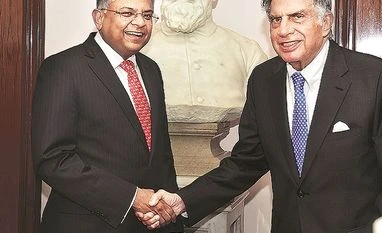
Chandra takes charge: New Tata Sons Chairman N Chandrasekaran with Ratan Tata at Bombay House. The latter quit the board on Tuesday.
Krishna KantDev Chatterjee
Last Updated : Feb 22 2017 | 10:43 AM IST
Tata Sons Chairman N Chandrasekaran, who took charge on Tuesday, vowed to bring “more vigour” to the group’s capital allocation policy to enhance shareholder value. On Day One, the new chairman promised to make the group companies leaders in their respective fields instead of being followers. 

But 54-year-old Chandra, as he is popularly known, is taking over the group when it is passing through a tough time in terms of returns on capital and cash generation. Tata Teleservices, Tata Motors’ domestic passenger vehicle business and Tata Steel lag in their respective sectors. Chandra is likely to take the issues head on as the group’s holding company has not earned financial returns on any big-ticket investment in the past one decade, barring Tata Motors. 

The group companies would now face greater scrutiny while seeking fresh equity investments from Tata Sons to fund acquisitions or new projects, said analysts. To offer better returns, the holding firm will have to put in thresholds for allocating capital, including the cost of capital for different types of risks and a criterion for returns on capital, they added.

This could put a leash on the history of sub-par investments made by Tata Sons in ventures such as Tata Steel’s acquisition of Corus (now Tata Steel Europe), Tata Teleservices, Indian Hotels’ foreign acquisitions, the acquisition of Tata Communication, Tata Power’s Mundra project and group’s retail ventures, among others.

Historically, Tata Sons has been one of the biggest equity investors and business promoters in corporate India. At the end of March 2016, the holding company had a direct controlling stake in 46 companies, including 32 unlisted ventures across several sectors. In all, Tata Sons has so far invested a little over Rs 53,600 crore as equity in various group companies.

In the past 10 years, Tata Sons’ direct equity investments (including preference shares) in the group’s listed and unlisted ventures grew at a compound annual growth rate (CAGR) of 19 per cent, much faster than the group companies’ underlying revenues and profits. In comparison, Tata Sons’ net profit grew at a CAGR of 6.5 per cent, indicating a mismatch between investment and financial returns.

The analysis is based on the investment schedule of Tata Sons as reported in its annual reports.

Excluding Tata Consultancy Services (TCS), which accounts for 95 per cent of Tata Sons’ dividend income, the equity dividend payout by other group companies grew at a CAGR of only 2.5 per cent in the past 10 years.

Two of its biggest listed companies — Tata Steel and Indian Hotels — made losses in FY16, while in the case of Tata Power, its fourth biggest investment, reported single-digit returns on equity in the previous financial year. Tata Motors and Titan Company are exceptions and reported high double-digit return on equity or net worth.

In the unlisted space, the group’s big bets are either loss-making or yet to mature. Tata Teleservices and broadcaster Tata Sky require a constant capital infusion to stay afloat. The group will have to either merge Tata Teleservices with another player or exit the business if it wants to follow’s Chandra’s promise to become a leader. With Idea and Vodafone set to announce a merger, and Reliance Jio pouring in money in its business, the fate of Tata Teleservices is sealed.

Tata Sons made an incremental capital infusion in 10 years in most of the key group companies including Tata Steel, Tata Motors, Indian Hotels, Tata Power, Tata Global Beverages, Tata Tele (Maharashtra), Tata Communications, Trent and Tata Investment Corp. Only three of the 13 companies in the sample — Voltas, Tata Elxsi and Titan Company — were self-financed and didn’t require an equity infusion during the period.

This differentiated performance has created a huge gap between Tata Sons equity investments in various listed companies and their market values. For example, Tata Steel accounts little over a third of all Tata Sons’ equity investments in listed companies but contributes only three per cent to the market value of its listed portfolio.

For Tata Motors, the ratio is 23 per cent (investment) and eight per cent (value), respectively. For Indian Hotels, its 6.3 per cent and 0.7 per cent, respectively. On the other hand is TCS, which accounts for 81 per cent of the market value of Tata Sons’ investment but only 0.5 per cent of all its investments. The software major is the group’s biggest value creator, pulling every other company along. Chandra would surely want to change this.


One subscription. Two world-class reads.

Already subscribed? Log in

Subscribe to read the full story →
*Subscribe to Business Standard digital and get complimentary access to The New York Times

Smart Quarterly

₹900

3 Months

₹300/Month

SAVE 25%

Smart Essential

₹2,700

1 Year

₹225/Month

SAVE 46%
*Complimentary New York Times access for the 2nd year will be given after 12 months

Super Saver

₹3,900

2 Years

₹162/Month

Subscribe

Renews automatically, cancel anytime

Here’s what’s included in our digital subscription plans

Exclusive premium stories online

  • Over 30 premium stories daily, handpicked by our editors

Complimentary Access to The New York Times

  • News, Games, Cooking, Audio, Wirecutter & The Athletic

Business Standard Epaper

  • Digital replica of our daily newspaper — with options to read, save, and share

Curated Newsletters

  • Insights on markets, finance, politics, tech, and more delivered to your inbox

Market Analysis & Investment Insights

  • In-depth market analysis & insights with access to The Smart Investor

Archives

  • Repository of articles and publications dating back to 1997

Ad-free Reading

  • Uninterrupted reading experience with no advertisements

Seamless Access Across All Devices

  • Access Business Standard across devices — mobile, tablet, or PC, via web or app

Next Story



