Home / Companies / News / Best B-school Project Award 2019: Solving real-world problems at India Inc
Best B-school Project Award 2019: Solving real-world problems at India Inc
Management students save cost and drive revenue in manufacturing, retail and finance sectors
premium
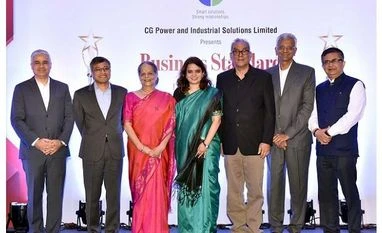
(Left to right) Jury members Sunil Panjwani, global head (internal audit), CG Power; Rajat Gupta, senior partner, McKinsey; Nishi Vasudeva, former CMD, Hindustan Petroleum Corporation; Rajkamal Vempati, HR head, Axis Bank; Ajit Balakrishnan, jury chairman and founder and chairman, Rediff.com; Ambi Parameswaran, founder, Brand-building.com; and Ashish Chauhan, MD and CEO, BSE, at the Business Standard Best B-School Project Award 2019 in Mumbai on Wednesday | Photo: Kamlesh Pednekar
4 min read Last Updated : Feb 12 2020 | 11:07 PM IST
Projects tackling real world challenges in the corporate world, including those on efficient hyperlocal delivery, sales technique for perfumes in malls, data analytics in microfinance, and improvements in automotive manufacturing were among the winners of the Business Standard Best B-school Project Award 2019 in Mumbai.
The top prize went to Kapil Gavali of National Institute of Industrial Engineering, Mumbai, for his project on the ideal picking, routing and storage policy for hyperlocal warehouse.
Using algorithms, Gavali developed a capability model for Flipkart for efficient and time-bound delivery to customers by reducing search and picking time in the warehouse, and also providing solutions of how the process can be improved further. "In a hyperlocal delivery model, timing is crucial. A business could lose a customer if it is unable to deliver on time. My project addressed this challenge," Gavali said.
G Teja of Vinod Gupta School of Management, at the Indian Institute of Technology-Kharagpur, was the first runner-up for his project on sales and marketing techniques for Titan Skinn perfumes in large format stores. Teja used a novel approach of distributing perfume sprayed blotter cards to mall visitors to increase footfalls and drive sales and also took steps to attract and retain counter staff.
The second runner-up prize was shared by Vivek Sathiamoorthy of Xavier Institute of Management and Entrepreneurship, Chennai, and Ayush Trivedi of Symbiosis Centre of Management and Human Resource Development. Sathiamoorthy developed an efficient model for transport of parts at BMW’s plant in Chennai as a part of his route train project and it led to better allocation of workforce, improved stock availability, reduced downtime and increased production.
Trivedi was recognised for his project on credit risk assessment and loan default prediction model that he developed for Samunnati Financial Intermediation, which provides financial and non-financial solutions in agri value chain. Trivedi used machine learning algorithms for business expansion and credit risk by gauging the propensity of default and reasons for default.
Rediff.com founder and chairman Ajit Balakrishnan said it was refreshing to see students tackling real world issues of Indian management referring to challenges in manufacturing and retail sector. “Historically management students tend to focus on financial analysis, financial forecasting or market research but today we saw students analysing manufacturing work flow, method of scheduling stock arrivals, and a hyperlocal warehousing and logistics project in retail,” he said. India has a crisis in manufacturing because the sector is unable to attract enough talent to tackle these problems, he added. “Typically, management students have turned their face away from these sectors and prefer consulting or Wall Street jobs. I am so glad their eyes are turning to these issues,” he said.
In his keynote address, Sujeet Kumar, co-founder of Udaan, shared the secret of his success which is hunger for knowledge, hiring individuals more capable than himself and giving space to them to grow | Photo: Kamlesh Pednekar
In his keynote address, Sujeet Kumar, co-founder of B2B e-commerce unicorn Udaan, shared the secret of his success, which is a hunger for knowledge, hiring individuals more capable than himself and giving space to them to grow. Kumar headed operations in Flipkart and left the e-commerce company in 2015 to set up Udaan with an aim to connect wholesalers with retailers. Kumar said in his Flipkart days he would look up to study the Amazon or Alibaba models but now companies in South East Asia want to study the Udaan model. “This is a validation of our idea,” he said.
Business Standard instituted the awards in 2007 to honour excellence among students from India's best business schools. The event's 13th edition saw participation of 174 entries for top honour, which were narrowed down to 15 projects first, and further shortlisted to five finalists. A seven-member jury chose the awardees based on individual presentations and question and answer session at a power-packed event attended by deans and faculties of management schools and students across the city.




