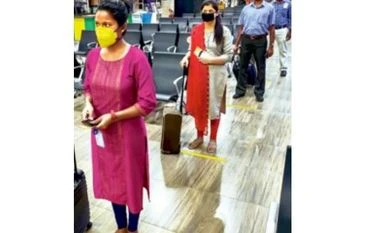
This past week saw the resumption of air services in parts of the country. For the airport leg of air travel, the “new normal” was fast-tracked, thanks to a slew of digital transition measures.
So how are the operators ensuring contactless travel and what were the challenges before them? How did they zero in on the new infrastructure to enable safe travel under the shadow of the coronavirus? More importantly, what does this means for the future of the industry?
Experts like Mark Martin, founder and CEO of aviation safety firm Martin Consulting, say the pandemic caught the Indian aviation industry off guard because prior to the crisis, the flying experience was largely contact driven. “Except for self check-in kiosks, we did not have anything that qualified as “contactless”. Compare this to Europe or Singapore where they have invested heavily in technology, where you just open an app and it navigates you through the entire process from your boarding gate to the correct seat,” he says.
In other words, airport operators back home had an uphill task ahead of them. The first step was identifying the touch points to reduce contact and go for sanitisation wherever that is not possible. These points were classified according to “stages” and corresponding solutions were put in place without delay. Broadly speaking, the changes, mostly driven by technology, kick in at the pre-entry, check in, security check and boarding processes, which are common for all passengers. So from magnifying glasses to read ID cards without touching them or using the
Arogya Setu app to screen passengers to the use of mobile phones to scan the QR code on the self-service kiosk, technology took over.
Coming to the food and beverages sale, the GMR group which operates the busy airports of Delhi and Hyderabad has introduced an app, HOI, that enables a passenger to order and pay digitally before reaching the airport or while waiting at the airport terminal. It also enables contactless payment. Similarly, at the Bangalore airport, passengers can pre-order F&B through their smartphones using the QR code displayed at the kiosks.
The food can be delivered at the passenger's place of choice within the terminal.
For all its usage, technology has its own limitations in reducing contact and then it comes to human restraint and rules like following the safe distance markers at the baggage collection area or not letting transit passengers leave the transit area like they did in the past.
Most changes are uniform and guided by the standard operating procedures provided by the authorities. However, operators also came up with innovative mechanisms of their own to ensure maximum safety. For example, placing trolley disinfection tunnels on departure ramps or retrofitting the hand rails with an automated system that provide a 360-degree sanitisation mechanism are some of the concepts developed by the GMR group which runs the airports at Delhi and Hyderabad. The trolley tunnels spray coat passenger baggage with a chemical disinfectant that evaporates by the time the luggage reaches the passenger on the belt.
At the Kannur airport in Kerala, an artificial intelligence system to check temperature has been installed that cuts out human intervention. V Thulasidas, managing director of Kannur Airport, says at present these devices have been installed at two of its gates; all seven would have the device by next week.
Such decisions couldn't have been taken without consultation among various stakeholders. Video conferencing and other remote working applications that have found traction across industries came in handy in carrying out these changes. As a Bangalore International Airport spokesperson puts it: “All additional infrastructure was procured in keeping with the strict guidelines that we normally follow, on an accelerated schedule. Due to long-standing relationships with most partners, the tests were conducted from remote locations, using BIAL’s in-house experts for support.”
“These changes will give confidence to airlines and passengers on the safety of air travel. This will kick-start the revenue cycle of the aviation sector,” says Kuljit Singh, transactions partner, EY.
That said, the journey hasn’t been glitch-free. Operators attribute the early hiccups to the short notice they got before restarting operations. Take Air India’s IT system that is waiting to be embedded in the server of private airports. That means an Air India flyer cannot print her boarding card outside the entry gate and has to do it at the kiosk inside the airport premises where touching the screen is unavoidable. Similarly, some airports like Delhi still await body scanner devices at pre-embarkation security check-points. So long — longer than usual — metal detectors continue to be used by security personnel during frisking. These longer metal detectors increase the distance between the passenger and the security person but ideally the whole process should be contactless. “The sudden announcement by the government to resume flights took us by surprise. Till the last moment, we weren’t clear about the number of flights that would be allowed to operate,” says an Airports Authority of India (AAI) official while discussing the initial hiccups.
And while these changes were pandemic-induced, the industry acknowledges that they are here for good.
Mumbai International Airport (MIAL) CEO Rajeev Jain said during a webinar on May 29 that compulsory web check-in would help in reducing the number of counters. He also highlighted the scope for another change — identification checks at the gate — and said that the industry has been working on it for a long time.