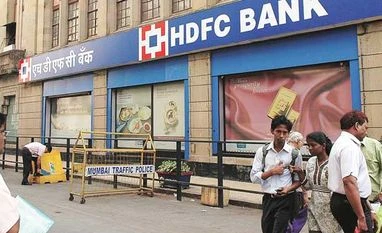
HDFC Bank on Friday reported a 20 per cent growth in net profit for the January-March quarter at Rs 3,374.2 crore. For the full financial year, net profit inched up 20 per cent to Rs 12,296.2 crore.
Net interest income, the difference between interest income and interest expenditure, grew 24 per cent to Rs 7,453.3 crore, against Rs 6,013.2 crore in the fourth quarter of the previous financial year.
Read more from our special coverage on "HDFC BANK"
Growth in net interest income was driven by a 27 per cent growth in loans, at Rs 4.64 lakh crore. While the domestic retail loan book grew 30 per cent, the retail loan book expanded 27 per cent. Domestic loan mix between retail and wholesale was 51:49.
Other income for the bank, including fees, commissions, forex gains, grew 11.8 per cent to Rs 2,563.8 crore in the quarter ended March. On a sequential basis, other income slipped marginally from Rs 2,872.2 crore.
Asset quality remained stable, with the percentage of gross non-performing assets (NPA) to gross advances at 0.94 per cent against 0.93 per cent in fourth quarter of FY15. However, it improved on a sequential basis — against 0.97 per cent in the quarter ended December. Net NPA also eased on a sequential basis. NNPA was 0.28 per cent against 0.29 per cent at the end of the third quarter of FY16.
The lender said it had taken some steps to keep NPAs in check. "We had pulled back a little in the small and the medium enterprise segment and agri business and we also reduced some exposure in specific segments in corporate to keep asset quality under check," said Paresh Sukthankar, Deputy Managing Director, HDFC Bank.
However, provisions and contingencies increased to Rs 662.5 crore (consisting of specific loan loss provisions of Rs 490.3 crore, general provisions of Rs 161.1 crore, and other provisions of Rs 11.1 crore) against Rs 576.7 crore (consisting of specific loan loss provisions Rs 424.7 crore, general provisions Rs 118.5 crore and other provisions Rs 33.4 crore) for the corresponding quarter ended March 31, 2015. The management said the increase in provisions was only to account for an increase in loan book.
Growth in the retail book was mainly driven by unsecured products-credit cards and personal loans. However, the management explained that there was no cause for concern with regards to this growth as the asset quality had been stable. In the wholesale segment, the growth was driven by working loans and by expanding the customer base.
Net interest margin, a key indicator of bank's profitability, was recorded at 4.3 per cent.
The lender remained well capitalised with a capital adequacy ratio of 15.5 per cent.

 "HDFC Bank Q4 net rises 20% to Rs 3,374 cr")


 Connect with us on WhatsApp