Honda drives beyond City, gets one-fourth sales from WR-V model

Sales of the City shrank by 25% in 2016-17 to 57,984 cars
graph
graph
Ajay Modi New Delhi
Last Updated : Nov 22 2017 | 1:02 AM IST

Don't want to miss the best from Business Standard?

Japanese carmaker Honda had a rough patch in India last year when its sales declined 18 per cent even as the market grew by 9 per cent. Having largely relied on the City for the bulk of its sales, Honda faced a challenge when the City acquired a competitor in the form of Maruti Suzuki’s Ciaz, which became the segment leader.

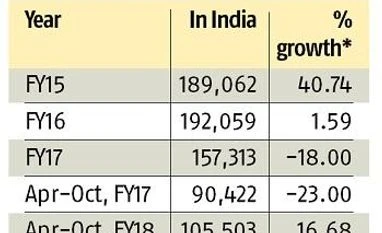
Sales of the City shrank by 25 per cent in 2016-17 to 57,984 cars. Accordingly, the model’s contribution to Honda’s car sales in India declined to 37 per cent from over 40 per cent in 2015-16. The launch of the BR-V sports utility vehicle in early 2016-17 did not help matters and Honda’s sales dipped 18 per cent to 157,313 cars. The company has managed to reverse the situation in the current financial year thanks to 7 per cent growth in the City’s sales after the launch of a new model.

Honda’s sales by volume have grown almost 17 per cent against 8 per cent growth in the industry overall. Besides the City, the big factor in Honda’s sales growth is the launch of an urban crossover, WR-V, in March this year. In the first seven months of 2017-18, Honda has sold 28,700 WR-Vs, at a monthly average of 4,100 vehicles. The WR-V has emerged as the second most sold Honda car in the country after the City. In the first seven months of the financial year, the WR-V brought in 27 per cent of the company’s sales of 105,503 cars. The City, irrespective of its 7 per cent sales growth, now contributes 34 per cent of sales against 37 per cent in the corresponding period of the previous financial year.


“Strong sales momentum for our latest offerings, the new City and the WR-V, helped us achieve good sales results this year. We are confident that Honda will post consistent growth in the coming months,” said Yoichiro Ueno, president and chief executive officer, Honda Cars India. 

With this, Honda has also strengthened its position as the fourth largest player in the Indian car market. The gap between car sales of Honda and Tata Motors, which had narrowed to a mere 1,446 during the April-October period of 2016-17, has now widened to over 7,600. Tata, the fifth biggest passenger vehicle player, is eyeing the third position by 2019, overtaking Honda and Mahindra & Mahindra. Honda and Tata sold 105,503 and 97,892 cars, respectively, during the April-October period. M&M is way ahead at 144,791 vehicles.


One subscription. Two world-class reads.

Already subscribed? Log in

Subscribe to read the full story →
*Subscribe to Business Standard digital and get complimentary access to The New York Times

Smart Quarterly

₹900

3 Months

₹300/Month

SAVE 25%

Smart Essential

₹2,700

1 Year

₹225/Month

SAVE 46%
*Complimentary New York Times access for the 2nd year will be given after 12 months

Super Saver

₹3,900

2 Years

₹162/Month

Subscribe

Renews automatically, cancel anytime

Here’s what’s included in our digital subscription plans

Exclusive premium stories online

  • Over 30 premium stories daily, handpicked by our editors

Complimentary Access to The New York Times

  • News, Games, Cooking, Audio, Wirecutter & The Athletic

Business Standard Epaper

  • Digital replica of our daily newspaper — with options to read, save, and share

Curated Newsletters

  • Insights on markets, finance, politics, tech, and more delivered to your inbox

Market Analysis & Investment Insights

  • In-depth market analysis & insights with access to The Smart Investor

Archives

  • Repository of articles and publications dating back to 1997

Ad-free Reading

  • Uninterrupted reading experience with no advertisements

Seamless Access Across All Devices

  • Access Business Standard across devices — mobile, tablet, or PC, via web or app

Next Story



