Shares of IDFC Bank and Capital First were up 4 per cent each, after the announcement that the merged entity — to be called IDFC First Bank — has commenced operations.
The combined entity is headed by V Vaidyanathan, founder and chairman of Capital First.
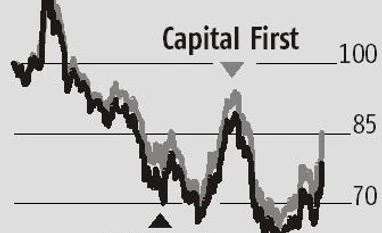
Analysts believe that the IDFC Bank stock (Capital First is merging into this), which has shed 21 per cent over the last year, has bottomed out.
“Currently trading at around its book value, I don’t see further downside for the stock,” says G Chokkalingam, founder of Equinomics Research.
The question, however, is whether investors should be lured by valuations in anticipation of improvement in financials.
The Street is divided on this. Since its inception, the bank has worked its way in terms of deposit growth, loan growth and bad loans.
While the bank closed the recently gone by September quarter (Q2) in red with a loss of Rs 3.7 billion, its net non-performing assets (NPA) has reduced from 1.6 per cent a year ago to 0.6 per cent.
Likewise, it has doubled its branch presence in a year to 203 branches, and increased the share of low cost current account-savings accounts (CASA) deposits to 13.3 per cent, from 8.2 per cent a year ago.
“As IDFC Bank has been investing in building processes, systems and infrastructure, the merger with Capital First will help build its retail franchise, bolstered by the latter’s execution capability,” said analysts in an Edelweiss Securities note.
That said, those at Deutsche Bank Research feel the merger with Capital First will only be accretive on the asset side, with pressure on liabilities becoming more acute.
Even now, despite the increase in CASA ratio, IDFC First Bank’s number is way below that of even the public sector banks on this metric.
On an average, the PSU banks maintain 33–38 per cent CASA ratio. Therefore the core operating parameters could remain under pressure given the planned expansion.
Chokkalingam also points out that while Vaidyanathan is an able leader who can take the bank to the next level, the intensity of penetration and competition could make his job challenging. Analysts say benign valuations will appeal only to long-term investors, as the bank faces multiple challenges over the medium term.

 "IDFC First's downside limited, but analysts divided on bank's future")












 Connect with us on WhatsApp