India’s position has slipped two notches to 142 out of 189 countries ranked by the World Bank in its Ease of Doing Business Report, 2015, against 140 in 2014. The ranking would seem worse, if one compares it with the provisional ranking of 134 in 2014.
The country's position came down even as its score rose to 53.97 points (out of 100) from last year’s 52.78. This was mainly because other nations performed much better, said World Bank officials. The score is calculated relative to the best scores since 2005.
“There is a continuous improvement across the world. India improved, but others improved at a faster pace,” said Rita Ramalho, lead author of the report.
Confederation of Indian Industry Director-General Chandrajit Banjeree said in spite of the drop, performance of India has improved over last year. “The performance of other countries have been better and therefore, India has dropped in ranking in spite of improved performance score.”
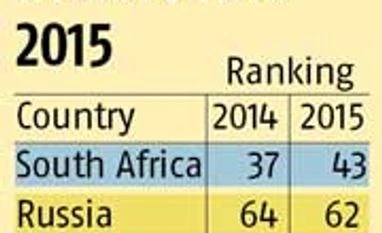
The ranking is a far cry from India’s declared aim of improving its position to 50th in two years. India’s ranking is lower than smaller countries in south Asia — Pakistan (128), Bhutan (125), Maldives (116) and Nepal (108). Its ranking is the lowest among BRICS nations, with South Africa positioned at 43, Russia at 62, China at 90 and Brazil at 120.
The only solace the incumbent government might get is that the report did not factor initiatives taken by it to improve business climate in the country.
The cutoff date of the annual report is May 31 and the new government assumed office on May 26.
“We do not want to send the impression that the drop in India’s ranking is connected in any way with the current political situation (government),” said Augusto Lopez-Claros, director, Global Indicators Group, Development Economics of the World Bank Group. He said whatever the government would do and whatever is in the pipeline is going to have an impact on these indicators only next year.
The report looks at 10 different factors while ranking a country. These factors range from ‘starting a business’, ‘dealing with construction permits’, ‘getting electricity’ to ‘paying taxes’ and ‘enforcing contracts’. WB ranks a country for each of these factors, too.
India dropped in the rankings in eight of the 10 factors surveyed, while it maintained its position at 186 (out of 189 countries) in ‘enforcing contracts’.
The only saving grace for India was the factor of ‘protecting minority investors’, the ranking on which jumped to 7th position (72.5 points) from its 21st position (65.83 points) last year.
“While this ranking tells much about the business environment in an economy, it does not tell the whole story. The ranking on the ease of doing business and the underlying indicators do not measure all aspects of the business environment that matter to firms and investors or that affect the competitiveness of the economy,” said the World Bank in its India report, which is published with these rankings.
World Bank officials said there was a very high likelihood of India significantly jumping up the ladder in the next report, taking into account the initiatives taken by the incumbent government.
Singapore with 88.27 points occupies the top position, followed by New Zealand, Hong Kong, Denmark and South Korea. Among other major countries, the US has been ranked seventh and Britain (eighth).
On the ambition of the Narendra Modi government to move up the ladder and gain a ranking within top 50 countries, Lopez said: “There is no reason, why not. Absolutely, it can be done. There are many examples of countries who through focused efforts, through intelligently designed reforms have managed to make very substantial improvement.”
The commerce and industry ministry has already taken several measures and has proposed a series of steps, including drastically reducing the time for registration of business to one day, single registration of all labour laws and cut in the number of taxes to improve ease of doing business in India.
“The aim is to improve the ranking to 50th position in two years from 134th at present. Different government departments have started consultation and deliberations on steps to improve India’s ranking,” a source said.
Banerjee said the new government’s vision to improve the ranking is achievable, especially in the light of the pace of actions taken by it. India has quite often criticised these rankings, which paint the country in poor light.
In a foreword to the report, World Bank Chief Economist Kaushik Basu said, “As an independent researcher and, later, as chief economic adviser to the Indian government, I used, criticised, valued and debated the Doing Business Report, unaware that I would be at the World Bank one day and, hence, be shifted from the side of the consumer to that of the manufacturer of this product.”
This shift has given him a 360-degree view of doing business and, along with that, an awareness of its strengths and weaknesses, which others, luckier than him, may not have, he quipped.

 "India 142nd in Ease of Doing Business report")


 Connect with us on WhatsApp