Indian carriers will have an order book of more than 1,000 aircraft - the third-largest in the world after the US and China. With roughly 550 commercial aircraft in service now, the new acquisition will translate into 2.2 planes on order for every single aircraft in service. Day One of the Hyderabad aero show was all about these lofty numbers, as top aviation executives spoke about their ambitious expansion plans.
The industry captains, including Vistara Chief Executive Officer (CEO) Leslie Thng, AirAsia India CEO Amar Abrol, and Jet Airways CEO Vinay Dube, were all there at Begumpet Airport in Hyderabad for ‘Wings India 2018’, a prominent exhibition for the aviation industry.
Even as the aero show hosted all segments of the aviation industry, the buzz on the buying frenzy was clearly being led by low-cost carriers (LCCs) such as IndiGo, SpiceJet, GoAir and AirAsia India. All these airlines are looking to add single aisle narrow body aircraft with a flying range of five hours to dominate the domestic market. Industry analysts pointed out that a prolonged period of low fuel price, coupled with increasing passenger numbers, has pushed Indian airlines to turn bullish about aircraft orders.
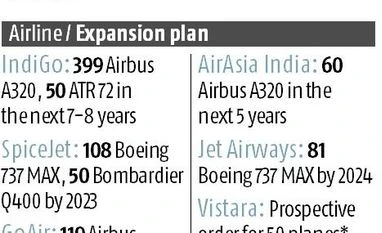
IndiGo has the largest order book in the world, with the airline looking to add around 450 planes in seven years. This includes an order for 50 ATR 72 planes, which the airline placed last year to foray into regional routes. The pace of addition may, however, slow down due to a technical disruption with the Pratt & Whitney engine which IndiGo uses for its A320neo planes. Company sources said the airline would maintain its target of 20 per cent annual growth by taking planes on lease from the secondary market.
Last year, IndiGo’s low-cost rival SpiceJet placed an order for 205 Boeing 737 MAX, the first of which will join the fleet in a few months. The airline also plans to add around 50 Bombardier Q400 in the next five years.
AirAsia India, after a slow start, has ramped up expansion plans and is looking to add around 60 planes in five years. CEO Amar Abrol said the airline wanted to boost its presence before flying international in early 2019. “We are expanding aggressively and aiming to be among the top three in the LCC segment, once we have inducted 60-70 aircraft in our fleet,” Abrol said recently.
Right now, it is a race among the LCCs, but full-service airlines too will join as growth of rivals will create a compulsion for them to expand, experts said.
Jet Airways CEO Vinay Dube on Thursday said the airline would double its order for Boeing 737 MAX. Jet is looking at an order for 75 planes soon. The airline already has 75 planes of this type on order. “We hope to close the deal with one of the manufacturers here shortly,” Dube said on the sidelines of the Hyderabad aero show.
However, such a pace of growth will test infrastructure and human resources capabilities. In fact, Airports Authority of India-owned airports have received a request from airlines to add 375 parking bays in the next five years. “This is unprecedented. Since the initial years of liberalisation in the sector, I have not seen such an aggressive growth plan,” said Kapil Kaul, CEO, South Asia, at aviation consultancy firm CAPA. “Signs of congestion are already emerging in Mumbai, Chennai and Delhi and the situation will become more acute unless airports are able to construct 400 parking bays and enhance airside capacity within five years. Otherwise, airlines will face challenges in implementing their base and network plans,” Kaul added.
Finding experienced crew will be another challenge. According to CAPA estimates, the industry will need 16,802 pilots by 2017, compared to roughly 7,000 available now.

 "Indian carriers ready to splurge on new planes in booming aviation market")












