Insolvency ordinance: Defaulting promoters all set to lose their companies

Wilful defaulters and borrowers with NPAs for a year or more cannot bid
graph
graph
Veena Mani New Delhi
Last Updated : Nov 24 2017 | 9:16 AM IST
An ordinance amending the Insolvency and Bankruptcy Code (IBC) has practically barred promoters of companies undergoing the resolution process from bidding for their own companies when they are auctioned as part of bankruptcy proceedings. 

Besides, sister concerns and corporate guarantors will also not be eligible to bid for these companies. 

The ordinance, promulgated on Thursday, added Section 29A to the Code: “A person shall not be eligible to submit a resolution plan if such person, or any other person acting jointly with such person, or any person who is a promoter or in the management control of such person, is an undischarged insolvent.” 


This prohibits promoters or sister concerns of companies with non-performing assets of more than a year from bidding for these companies. In order to bid, promoters will have to make the NPAs standard assets by paying the principal and interest. 

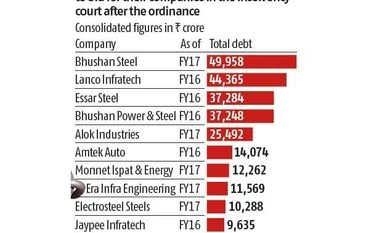
However, even this is not allowed once the National Company Law Tribunal (NCLT) has accepted an insolvency petition. None of the promoters or their associates can buy the stressed assets of the 12 large debt accounts suggested for insolvency proceedings by the Reserve Bank of India.


Wilful defaulters also have been banned from buying stressed assets. Officials said wilful defaulters were fly-by-night operators and were anyway unlikely to bid for companies.  

They added promoters were not debarred from bidding unless a case was admitted in the NCLT, but merely discouraged. If a company paid, say, Rs 10,000 crore out of its total NPAs of Rs 50,000 crore to convert the loan into a standard asset, the insolvency process would benefit, they said. 


Insolvency professionals were divided on the Ordinance. Nilesh Sharma, senior partner at Dhir and Dhir Associates, said the government should remove the clause that prohibits any account with NPAs of over one year from bidding.

The big concern among resolution professionals is the amendments will disrupt nearly all pending insolvency proceedings. Besides, the eligibility of all bidders will have to be ascertained before examining their bids.   “Earlier, the resolution plan had to qualify for consideration, now the bidder must also qualify.  In cases where only the promoter has submitted a plan, and such promoter is found to be ineligible, fresh bids will need to be invited," said Sumant Batra, managing partner of Kesar Dass B & Associates.

ALSO READ: Edit: Jolt for errant promoters

Companies are allowed 180 days to find a resolution plan after a case is admitted by the NCLT. This period can be extended by 90 days. If 270 days elapse or no bidder comes forward, the debtor will be pushed into liquidation. Identification of wilful defaulters has been left to banks, which experts said might lend arbitrariness to the exercise even though it followed RBI guidelines. "A provision that is punitive or takes away a right must be enshrined in the statute as a substantive provision and not left to be determined by an interested party (lender)," an expert said.

The risk is that a promoter can challenge such determination by a lender in court and seek a stay on insolvency proceedings till the challenge is decided. 

A court might not stay the insolvency process and the promoter could lose his company, but later if the bank's decision were found to be illegal by court, the promoter would become entitled to claim damages, experts added. The amendments also place foreign bidders in an advantageous position as the concept of wilful defaulter may not exist in other countries and the disqualification criteria in corresponding situations may be different.  


There are others who support these amendments. “This will reassure new investors about the credibility of the process. Steps taken to provide clarity and reduction of transaction costs associated with resolution would be welcome and will provide for greater participation by investors and more innovative resolution processes,” said Manish Aggarwal of KPMG in India.


One subscription. Two world-class reads.

Already subscribed? Log in

Subscribe to read the full story →
*Subscribe to Business Standard digital and get complimentary access to The New York Times

Smart Quarterly

₹900

3 Months

₹300/Month

SAVE 25%

Smart Essential

₹2,700

1 Year

₹225/Month

SAVE 46%
*Complimentary New York Times access for the 2nd year will be given after 12 months

Super Saver

₹3,900

2 Years

₹162/Month

Subscribe

Renews automatically, cancel anytime

Here’s what’s included in our digital subscription plans

Exclusive premium stories online

  • Over 30 premium stories daily, handpicked by our editors

Complimentary Access to The New York Times

  • News, Games, Cooking, Audio, Wirecutter & The Athletic

Business Standard Epaper

  • Digital replica of our daily newspaper — with options to read, save, and share

Curated Newsletters

  • Insights on markets, finance, politics, tech, and more delivered to your inbox

Market Analysis & Investment Insights

  • In-depth market analysis & insights with access to The Smart Investor

Archives

  • Repository of articles and publications dating back to 1997

Ad-free Reading

  • Uninterrupted reading experience with no advertisements

Seamless Access Across All Devices

  • Access Business Standard across devices — mobile, tablet, or PC, via web or app

Next Story


