Kamath leaves behind troubled legacy as Infosys chairman
The time Kamath spent as chairman was one of the toughest periods in the history of the IT bellwether
BS Reporter Bangalore Barely two years after he was appointed the chairman of Infosys, K V Kamath stepped down from the role on Saturday to pave the way for the comeback of N R Narayana Murthy.
The time Kamath spent as chairman was one of the toughest periods in the history of the IT bellwether. At a time when Infosys was trying to come out of the worst economic cycle that followed the Lehman Brother's collapse in 2008, the company saw the exit of Murthy. The firm was also in the news for the exit of various senior-level leaders including T V Mohandas Pai, then a director on the board.
In Kamath's own words, both the external and internal environments were quite tough. Slow growth over several quarters has drawn criticism from various stakeholders including the shareholders. In one of the worst performances since its inception, the firm's revenues grew an unimpressive 6.6 per cent in FY13.
Also, the company's revenue growth projection for FY14 at 6-10 per cent was far below the industry projection of 12-14 per cent growth further added to its woes followed by a slew of downgrades. More importantly, the firm stopped giving quarterly revenue guidance, which it had always consisted as a 'statement of facts', signifying the lack of management confidence. Infosys' profit margin, which was once the best in the industry, came down to 23.6 per cent in the quarter ended 31 March 2013.
"As you know, everyone has a duty, called as duty of care. We need to care about the external and internal environment, and most importantly, what the stake-holders are communicating to us through verities of ways," said Kamath, justifying the board's decision to bring back Murthy at the helm of the company again. In a way, Kamath indicated that the decision to bring back Murthy was, to a great extent, related to Infosys' poor performance in recent times.
Who was to be blamed for the company's state of affairs? According to industry analysts, Kamath was only the non-executive chairman of the board, which means he had absolutely no role in the day to day functioning of the company or its executive decisions. Kamath had made it clear that other than chairing the board, he would be instrumental in grooming and identifying the nest set of the leaders who can take the mantle from the co-founders after their retirement.
"While Kamath should not be blamed for the current financial condition of the company, in a way, he at least foresaw that the company needs someone dynamic and who is well-versed with the functioning of the IT business to take up as the chairman of board in executive capacity," said an industry analyst on condition of anonymity.

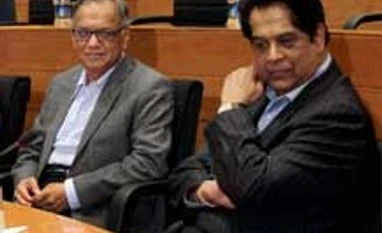 "Kamath leaves behind troubled legacy as Infosys chairman")

