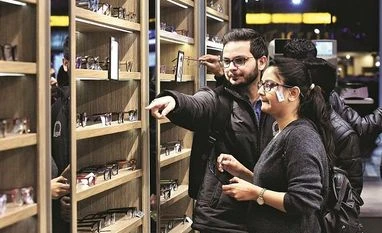
By the end of this month, eyewear retail brand Lenskart is expected to cross the milestone of 500 stores. Having already turned profitable and attained the number one position in the branded eyewear category, the nine-year-old start up is looking to build on the gains with a focus on Tier 2 and Tier 3 cities.
While the company is already present in these centres, its founder and chief executive officer Peyush Bansal sees more scope of growth in the non-metros. At present, the company has 476 retail stores in over 70 cities with nearly 300 in the metros while the remaining ones are in smaller cities. “The traditional markets have been good for us and next year, we will go very aggressive in the Tier 2 and 3 markets,” he says while not divulging the number of new stores planned. Bansal, however, says of the 24 new ones coming up in March, the ratio is 50:50.
The venture started as an online app and later developed into an omnichannel business with offline taking the driver’s seat. The physical stores thus would be crucial in newer territories too, believes Bansal. “A couple of years ago, we realised that some companies were burning a lot of money to compensate for the trials and we thought we did not want to do that. It was more sensible to actually solve that need for the consumer. The problem was of trial and not so much of inventory,” says Bansal.
He adds that the response to the stores — where a customer could get a feel of the eyewear along with optometrist services — was good. “The stores were profitable in the first month itself. And this was better marketing than the loss making marketing others were doing,” he says looking back.
The company is also known for its deep discounts and promotional offers — the most popular being first frame free — and offering a big range of products in the prescription eyewear category at prices ranging from Rs 345 to Rs 30,000. In the newer markets or stores, however, the company doesn’t have plans to give heavy discounts. It is hoping that thanks to a second manufacturing unit it set up in China last year, it would be able to ensure quick supplies and competitive pricing.
“The traditional markets have been good for us and next year, we will go very aggressive in the Tier 2 and 3 markets” Peyush bansal Founder & CEO, Lenskart
The average store size in metros and smaller centres is 600 and 300 square feet respectively. In the bigger markets, the rentals are higher, but it prefers to follow a company-owned model. In the smaller markets, franchisees lead, says Bansal. In its assortment, the company also stacks products from other brands. But they constitute about 5 per cent of a store's offering. Bansal says his stores tend to get more queries related to its own label and that gives it an opportunity to customise products.
What has really fuelled the needs for eyewear in smaller and bigger centres alike is the fact that these are seen as both a necessity and a fashion statement nudging buyers to buy more that one pair of glasses for every occasion, says Siddharth Shekhar Singh, associate professor (marketing), Indian School of Business. “Once people have discretionary income, they start consuming more of products that are not deemed a necessity. Also growth in Tier 2 and Tier 3 cities is almost on par with the big cities in India, unlike in many other countries,” says Singh. Bansal says that such a trend was already evident when Lenskart entered the market but claims credit for taking it to the next level. He also remains bullish that this trend will not slow down and people will continue to buy more pairs of glasses. “We have seen that journey with shoes and it is happening in eyewear too. Once you start appreciating the fashion accessory part of it, you stop thinking why should I have another pair,” he says.
According to Bansal, the total eyewear market is close to Rs 15,000-20,000 crore and about Rs 2,000 crore is organised, of which the market share of Lenskart is 25 per cent. Without putting a number to the annual growth rate of the organised eyewear market, Bansal estimates that in the past five years, it has doubled. His own company has grown at more than 50 per cent in this period and he doesn’t see that momentum slowing down, though he expects the company to grow at 40 per cent this year.
While there are other players such as Titan Eye Plus or Zeiss dealing in prescription glasses, Bansal believes that the competition will now be for a bigger slice in the overall pie which means taking on the unorganised market players.
Rajat Wahi, partner, Deloitte India, pegs the growth of the organised market at 15 per cent while that of the unorganised marker at anywhere between 8 and 10 per cent. However, the foreseeable challenges for the branded players could be the entry of other established retail players. “Their success will give an impetus to the unorganised market to move into some kind of a semi-organised play,” he says.
While adding that life is not going to be easy for the very small retail stores in big cities, Singh also cautions that the brands can’t take the buyers in these centres for granted as there is a constant demand for quality there as well.
What do the unorganised category players feel about this prospective change? BS spoke to Anil Wadhwa, the president of Delhi Optician association. He says that even those in the unorganised market are gaining from people’s penchant to own more than one pair of eyeglasses. “The margins have been reduced but volumes have grown because the demand has risen. Online sure comes with certain advantages but grievance redressal is not as swift as with local shopkeepers. That, sometimes, causes dissatisfaction,” says Wadhwa.