Maggi fiasco returns to haunt Nestle India as SC revives class action suit

The court also upheld Nestle's stand by not allowing any further sampling or testing exercise
Chart
Aashish AryanArnab Dutta New Delhi
Last Updated : Jan 04 2019 | 2:45 AM IST
More than three years after the Maggi ban, the ghost of the 2015 fiasco seems to be back to haunt Nestlé India, the maker of Maggi noodles.

The Supreme Court on Thursday revived a class action suit filed by the Union government against the Swiss food major for allegedly selling noodles that were unfit for consumption. The quality of the widely sold instant noodle is again expected to be under the scanner of the National Consumer Disputes Redressal Commission (NCDRC).

On Thursday, while the Supreme Court allowed the class action suit by the NCDRC, it upheld Nestlé’s stand by not allowing any further sampling or testing exercise. 

Any further probe, it said, will proceed on the basis of the old report filed by the Central Food Technological Research Institute (CFTRI), Mysore. The CFTRI had found lead at a level lower than what the Food Safety and Standards Authority of India (FSSAI), the country’s apex food regulator, permitted. It further pointed out that despite the presence of monosodium glutamate (MSG) in Maggi samples, it was unable to determine whether it was from natural sources or added artificially. According to the Food Safety and Standards Act, there is no ban on food items that contain MSG occurring from natural sources.

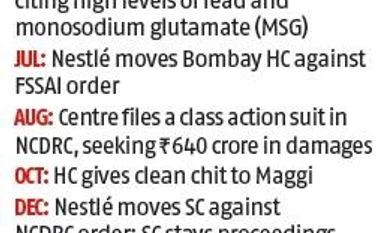
The FSSAI banned all variants of Maggi noodles on June 5, 2015, after initial tests confirmed the presence of MSG and high levels of lead in them.

The long-drawn battle between the Union government and the food major gathered steam in August 2015, when the consumer affairs ministry filed a class action suit against Nestlé India in the NCDRC, seeking Rs 640 crore in damages. The move was the first such instance when the Union government had, suo motu, filed a class action suit against a firm. In a separate piece of litigation, the FSSAI and Nestlé continue to fight over the quality of Maggi noodles

“The class action suit was filed under Section 12(1) (d) of the Consumer Protection Act, 1986. It was the first time that the government invoked this Section against a company. The same has not been used since,” advocate Nitish Banka, who has followed the case, said.

The government had, in its plea before the consumer disputes commission, alleged that Nestlé India, with the tagline “Taste bhi healthy bhi”, had misled consumers by claiming that Maggi was healthy, when its products contained lead and MSG.

The class action suit in the NCDRC was stuck when Nestlé approached the Supreme Court in December against the NCDRC’s interim orders seeking fresh sampling and lab tests on Maggi noodles. The firm had argued that tests conducted in non-accredited laboratories were not fit for consideration, citing a Bombay High Court order that gave a clean chit to Maggi noodles in October, citing similar reasons. 

The CFTRI is a government accredited laboratory. 

Welcoming the Supreme Court order, a Nestlé India spokesperson said, “The Supreme Court, in view of reports from the CFTRI, has agreed with Nestlé’s contention and has set aside both the interim orders passed by the NCDRC which were challenged by Nestlé.” 

After a sharp drop, once the Supreme Court order came out, Nestlé India’s stock ended 1.36 per cent higher at the BSE at 11,191.10 on Thursday.

Litigation between the FSSAI and the food company, which went to the apex court after the Bombay High Court order, is expected to come up this month. However, sources in the FSSAI say that disagreement over the quality of products collected from Nestlé has been resolved and the regulator is satisfied with the company’s initiatives on the front. However, it is expected to take up certain reservations in the Bombay High Court, which rejected reports of non-accredited labs. “These state labs are in delivering appropriate results and we are working with them. Thus, it is not feasible to outright reject their credibility,” said a senior official at the FSSAI.

Since its re-entry in November 2015, Maggi noodles regained top slot. However, its market share continues to remain lower — at 60 per cent — than the pre-ban level. The brand raked in over Rs 2,600 crore in 2017.


One subscription. Two world-class reads.

Already subscribed? Log in

Subscribe to read the full story →
*Subscribe to Business Standard digital and get complimentary access to The New York Times

Smart Quarterly

₹900

3 Months

₹300/Month

SAVE 25%

Smart Essential

₹2,700

1 Year

₹225/Month

SAVE 46%
*Complimentary New York Times access for the 2nd year will be given after 12 months

Super Saver

₹3,900

2 Years

₹162/Month

Subscribe

Renews automatically, cancel anytime

Here’s what’s included in our digital subscription plans

Exclusive premium stories online

  • Over 30 premium stories daily, handpicked by our editors

Complimentary Access to The New York Times

  • News, Games, Cooking, Audio, Wirecutter & The Athletic

Business Standard Epaper

  • Digital replica of our daily newspaper — with options to read, save, and share

Curated Newsletters

  • Insights on markets, finance, politics, tech, and more delivered to your inbox

Market Analysis & Investment Insights

  • In-depth market analysis & insights with access to The Smart Investor

Archives

  • Repository of articles and publications dating back to 1997

Ad-free Reading

  • Uninterrupted reading experience with no advertisements

Seamless Access Across All Devices

  • Access Business Standard across devices — mobile, tablet, or PC, via web or app

Next Story



