Home / Companies / News / Media houses grapple with information overflow
Media houses grapple with information overflow
As the world moves to digital, media houses in India are trying to figure out what works best on the digital medium, in terms of content and viable business models
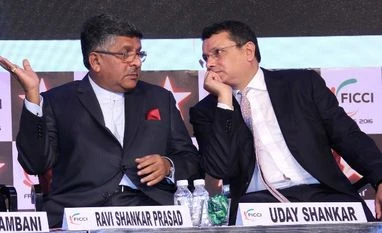
Ravi Shankar Prasad, Union Minister of Communications & Information Tecnology, Uday Shankar, CEO, Star Network during the inaugural session of FICCI Frames 2016 in Mumbai on Wednesday (pic:
As digital media gains prominence, media houses are grappling with the issue of information overflow on the medium. Addressing ‘FICCI Frames’ media and entertainment conference, broadcasters and content producers agreed that producing premium and exclusive content is the way forward.
With the penetration of smartphones and rising mobile internet usage, digital media content consumption is estimated to go up manifold in the coming years. However, advertising on the medium has not picked up proportionally. Revenue in this segment constitutes 12.6 per cent of total advertising spending.
Experts say digital media needs to be looked at as a separate entity because content that works on TV or print might not drive the same eyeballs on digital. Media houses like Viacom18 and STAR India are tackling this by providing live content in addition to archived television content on their platform. While STAR India has put its money on live sports streaming, Viacom18 has decided to go for a mix of archived, exclusive, television content on its VOOT platform.
Vikram Chandra, chief executive officer, NDTV says, “The kind of space a company operates in will decide how relevant sharing on digital is. For a media house, text or video content means more reach and eyeballs, which is preferred. But, for some content like movies, sharing a pirated version is not a good scenario. We should look at the kind of content we deal in before chasing market shares.”
Aroon Purie, chairman and editor-in-chief, The India Today Group said there was a need for improvement in analytics of consumer behaviour in media to create relevant and quality content. The fundamentals have remained same for digital which was content needs to be exclusive. He added that today organisations, even traditional media companies, do not have a choice and need to adopt digital media, given the huge number of consumers in the medium.
Another challenge that content companies face on digital is monetisation. Here, the industry seems divided. While on the one hand, some feel that the need of the hour is to promote habit formation of consuming content on digital, which can then be converted to transactions, there are those that feel the land-grab philosophy may not be the best way to go about tackling digital media consumption and business generation.
Siddharth Roy Kapur, managing director, Disney India reiterated the point giving the example of live sports and movies. “When we started cinema halls and stadiums, if we would have said let people watch films or cricket matches for free till they form a habit and then start charging them, people would not have accepted that as a business model. While disruption from traditional method is required, I do not think we need to completely break away from the practices in place so far.”
He also added that in case of films, he believes that two distinct buckets will be formed. “We see it happening in the west where the big franchise films are essentially made for cinema halls, while the more intimate, smaller films are suitable for consumption on the smaller screens,” Roy Kapur said.
Experts also added that digital will not take over the M&E space in the near future. In case of print, regional and Hindi publications will continue to attract advertisers given their penetration in the country. In contrast, digital penetration is at around 30 per cent according to the most optimistic estimates. In case of TV, new technologies will continue to evolve and bring value to the TV viewing experience. As of now, multiple screens will continue to co-exist and content will need to adapt according to the audience on a particular screen.

 "Media houses grapple with information overflow")


 Connect with us on WhatsApp