4 min read Last Updated : Feb 22 2022 | 6:07 AM IST
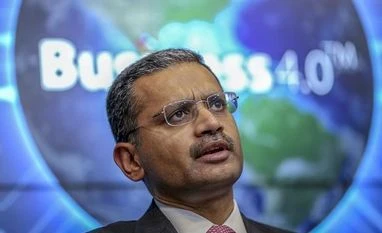
It has been five years since Rajesh Gopinathan, chief executive officer and managing director, Tata Consultancy Services (TCS), took over the reins of the information technology bellwether. The company’s market capitalisation has more than doubled from $84 billion in 2017-18 to $184 billion as on date. Its revenues have climbed to $25 billion in calendar year 2021, from $18.5 billion in calendar year 2017. But analysts say the next five years will define Gopinthan’s legacy at TCS.’
Enclosed in that legacy will be how Gopinathan steers the largest private sector recruiter that TCS has come to be, with over 550,000 employees. While scale is always daunting, it will be his ability to make the company agile that will hold the key.
The company has successfully pivoted to a digital business without an inorganic play, putting digital at the heart of strategy. Analysts tracking the company say its approach to not look at acquisitions to enter newer segments was seen with pessimism, but Gopinathan managed to drive the digital strategy well.
“To pivot a company such as TCS to a completely new format of digital environment is indeed a job done well. While there will be comparisons with Chandra (N Chandrasekaran), I think Rajesh has made his mark, especially when he said that the company needs to be re-evaluated and should get fast-moving consumer goods-kind of valuations,” says Pareekh Jain, founder, Pareekh Consulting.
If the first five years of TCS were spent getting a foothold and gaining expertise in navigating the digital world, Gopinathan has already called out his next focus area: taking market share in the consulting space or what he calls the growth and transformation (G&T) segment.
He believes that the next $25-billion revenue will be driven mainly by the G&T projects undertaken by its clients, helped by a sustained move towards Cloud-based offerings. The company, under Gopinathan, has carved up this journey into three parts: Horizon 1, 2, and 3. The first involves moving workloads on to Cloud and using infrastructure-as-a-service as the primary value proposition.
Horizon 2 is when native capabilities of Cloud are leveraged to generate significant transformation at the company level. Finally, with Horizon 3, the ecosystem play becomes a crucial driver for what TCS sees as the industry structure of the future.
“TCS has been a stable company over the past five years, especially when the market has seen its fair share of challenges. It’s not that TCS has remained untouched. But it has managed to stay the course, albeit slow, but always catching up. That says a lot about its leadership structure,” says D D Mishra, senior director analyst, Gartner.
Mishra points out that the next five years will be crucial, especially with the size it has acquired. “Agility will be significant. TCS will need to have vision. More importantly, it needs to focus on three aspects: risk-taking ability, eye on the evolution of the tech landscape, and the ability to respond,” he adds.
Insiders say that one of his biggest contributions in terms of human resource is the focus on diversity. Not only has the women ratio increased to 36 per cent of its total workforce, the company is also getting more women to assume leadership roles.
“Chandra had a vision for the company and a lot of the present-day operations are what he put in place. I think Gopinathan will need to pull up, given the old TCS model was based on large deals. The reality, however, is different. Large deals are off the table, digital deals are smaller in size and of shorter duration. TCS has to think like the global players. Consulting and winning the digital growth story is fine, but it needs to think of scale, newer markets to capture, and service lines to launch,” observes an analyst.