Reliance Jio vs incumbents: Govt assures telcos of 'corrective steps'

The telecom industry's outstanding debt was to the tune of Rs 4.5 lakh crore
Telecos, Manoj Sinha, Communications Minister
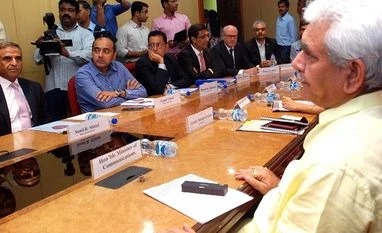
Founder & Chairman of Bharti Enterprises Sunil Bharti Mittal with Gopal Vittal CEO of Bharti Airtel and Himanshu Kapania MD of Idea Cellular Limited at meeting with Telecom Minister Manoj Sinha in New Delhi on Thursday. Photo: Dalip Kumar
Kiran Rathee New Delhi
Last Updated : Jun 23 2017 | 8:53 AM IST
The government on Thursday assured the telecom sector it would take corrective steps to ensure growth, and deal with financial stress and declining revenues.

Union Minister of Communications Manoj Sinha met top bosses of telecom firms including Bharti Enterprises founder and Chairman Sunil Mittal, Reliance Group Chairman Anil Ambani, Tata Sons Director Ishaat Hussain, Reliance Jio board member Mahendra Nahata, and Idea Cellular Managing Director Himanshu Kapania.

Six telecom firms presented their views to the minister. Notable absentees from the meeting were Vodafone and Aircel.

According to sources, incumbent operators stressed the issue of interconnect usage charges (IUC), which has been a bone of contention ever since Jio entered the market.

Airtel, Idea, Tata Teleservices, and Telenor said the current IUC regime was below cost and needed to be revised. IUC is paid by a telecom operator to another when its call terminates on the latter’s network. Currently, the charges are 14p per minute.
   
According to sources, Mittal, who was very direct and forthcoming in the meeting, said a network could not be built to serve others and, therefore, IUC needed to be revised. It had been last reviewed when spectrum was bundled with licence and the cost was nil.

The incumbents and Jio have been at loggerheads over the traffic of incoming calls. Idea’s Kapania proposed a floor pricing for tariffs, giving examples of Sri Lanka and Bangladesh. Jio said IUC should be removed. 

Mukesh Ambani-led Jio also said it wanted to remove the misconception of stress. Revenues dipped when new operators entered the sector, as was the case with BSNL and VSNL in 2002-03, when private operators were allowed to offer national long-distance and international long-distance call services.

Tata Teleservices said the biggest cost was spectrum and deferred payments should be aligned to the licence period. Airtel, Idea and Telenor supported the idea of deferred payments. 

Operators also sought reduction in licence fees, lower spectrum-usage charges, abolition of USOF levy and a lower goods and services tax rate. 

Assuring the industry, Telecom Minister Sinha said, “Corrective steps will be taken by the government for ensuring orderly growth in the sector in terms of services to the common man, including in rural areas.” He also said the inter-ministerial panel has already held consultations with banks and telecom firms and was likely to submit its report soon. An SBI representative present at the meeting sounded alarm bells, pointing out that Ebitda had gone from Rs 75,000 crore two years ago to Rs 45,000 crore last year.

SBI Managing Director B Sriram said the industry had a deficit of about Rs 80,000-90,000 crore, taking into consideration interest payments, loan repayments, and capex requirements.

Tuesday’s meeting came days after an inter-ministerial group completed its deliberations with the industry over the financial stress and measures that can be taken to ease the situation. Jio had blamed the incumbent operators for the financial stress in the sector and claimed that they were running businesses on debt and investing heavily in unrelated sectors.

After the two-hour long meeting, asked about Jio’s allegations that incumbents were not infusing enough equity, Mittal said, “You can see our balance sheet.” 

The financial health of the telecom sector has taken a beating, mainly because of hyper competition unleashed by Reliance Jio, which commercially launched its services from September last year. 

The country’s top operator, Bharti Airtel’s net profit slid for the past few quarters. Vodafone, Idea Cellular and Reliance Communications, too, saw erosion of earnings.

Reliance Communications, after defaulting on payments, has seven months to make them.

The telecom industry’s outstanding debt was to the tune of Rs 4.5 lakh crore.

One subscription. Two world-class reads.

Already subscribed? Log in

Subscribe to read the full story →
*Subscribe to Business Standard digital and get complimentary access to The New York Times

Smart Quarterly

₹900

3 Months

₹300/Month

SAVE 25%

Smart Essential

₹2,700

1 Year

₹225/Month

SAVE 46%
*Complimentary New York Times access for the 2nd year will be given after 12 months

Super Saver

₹3,900

2 Years

₹162/Month

Subscribe

Renews automatically, cancel anytime

Here’s what’s included in our digital subscription plans

Exclusive premium stories online

  • Over 30 premium stories daily, handpicked by our editors

Complimentary Access to The New York Times

  • News, Games, Cooking, Audio, Wirecutter & The Athletic

Business Standard Epaper

  • Digital replica of our daily newspaper — with options to read, save, and share

Curated Newsletters

  • Insights on markets, finance, politics, tech, and more delivered to your inbox

Market Analysis & Investment Insights

  • In-depth market analysis & insights with access to The Smart Investor

Archives

  • Repository of articles and publications dating back to 1997

Ad-free Reading

  • Uninterrupted reading experience with no advertisements

Seamless Access Across All Devices

  • Access Business Standard across devices — mobile, tablet, or PC, via web or app

Next Story


