Ruias to give up Essar Oil control
Group in talks to sell 25% more stake, months after Rosneft agreed to buy 49% for Rs 19,000 cr
Dev Chatterjee Mumbai The Ruias have decided to become minority stakeholders in Essar Oil and give away their control over management. Months after striking a deal to sell 49 per cent stake to Russia's Rosneft, the Ruia family has initiated talks to sell another 25 per cent to an oil trader or a strategic investor, leaving the family with only 24 per cent stake.
Both transactions are expected to close in the next two months, a source close to the development said. The new owners would induct their own nominees on the board, which has only one director, Prashant Ruia, from the family that currently owns 98 per cent stake in Essar Oil. Two per cent of Essar Oil is owned by minority shareholders, who did not participate in the delisting offer made by the promoters in December last year.
A top company official had earlier indicated the group would get $2.8 billion (Rs 19,000 crore) in cash for its 49 per cent stake from Rosneft. Additional stake sale was necessary to repay lenders in India and the company was getting a good valuation, the source said. The company could go for a branding transformation but it is not a top priority, the source said, asking not to be named.
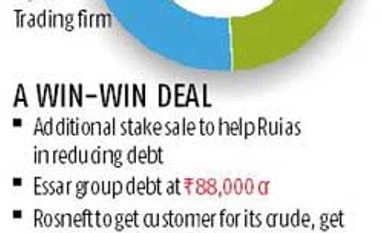
Apart from the 20 million tonnes per annum (mtpa) refinery, the sale would cover Vadinar Power Company, two ports and 2,200 retail outlets, which are crucial for the refinery's operations. The deal is vital for the Essar group to reduce its consolidated debt of Rs 88,000 crore. As on March 2015, the Essar Oil debt was Rs 27,127 crore. Taking the Rosneft valuation, the additional stake sale would fetch the group an additional Rs 9,643 crore. The new promoters would take over the debt of Essar Oil, Vadinar Power and the port companies. The proceeds of equity sale by the Ruias will be used to repay the bank loans.
"The transaction for Rosneft to purchase 49 per cent in Essar Oil is in an advanced stage. Appropriate announcements will be made in due course, as and when definitive agreements are executed. The proceeds will be primarily used to reduce the group's debt exposure. Your query on further stake sale is speculative and the company does not comment on market speculation," said an official spokesperson.
The exit of the Ruias from the controlling stake in Essar Oil ends a chapter for the group, which entered the business in the mid 90s. Construction of the refinery was delayed for a considerable time because of a cyclone and regulatory delays before starting commercial production in May 2008 at Vadinar, Gujarat.
Rosneft would use Vadinar refinery to process its crude produced in Russia and then sell it to Indian customers. Essar Oil is expecting to make an Ebitda (earnings before interest, tax, depreciation, and amortisation) of Rs 10,000 crore by the end of financial year 2017 as compared to Rs 7,000 crore as on March this year. At the time of delisting in December 2015, the company earned revenue of Rs 40,367 crore and made profits of Rs 2,700 crore for the nine months ending December 2015. The Essar group was under pressure from the banks to reduce debt which went up to Rs 88,000 crore as on March this year. The group was planning to sell 30 per cent stake in its steel company but dropped the plan as it could not find any takers. In the past few years, the group sold its US-based business process outsourcing (BPO) unit for $610 million (Rs 4,119 crore), Vodafone India stake for $5 billion (Rs 33,000 crore) and real estate, including an office complex in Mumbai's Bandra Kurla Complex, for Rs 2,700 crore.
While the group's oil refining business did well but its steel business failed to make money because of falling steel prices, lack of gas supply from the Krishna Godavari Basin and damage to its Kirandul-Vizag slurry pipeline by Naxals in October 2011. The lack of gas supply brought down the capacity of the company's Hazira plant to 40 per cent. The steel business has been recovering on the back of an import duty on cheap Chinese steel imports and increased gas supply.

 "Ruias to give up Essar Oil control")


 Connect with us on WhatsApp