Sebi asks Goyal to sell 6% more in Jet
Wants stake sale before Jet makes allotment to Etihad
Samie ModakAneesh Phadnis Mumbai Market regulator Securities and Exchange Board of India (Sebi) wants Naresh Goyal to sell another 6 per cent stake in Jet Airways before the company makes its proposed 24 per cent preferential allotment to the Abu Dhabi-based Etihad Airways.
Though public shareholding in Jet is already down to the mandated 25 per cent, the regulator wants its promoters to pare their stake further to ensure better corporate governance and broad-based shareholding.
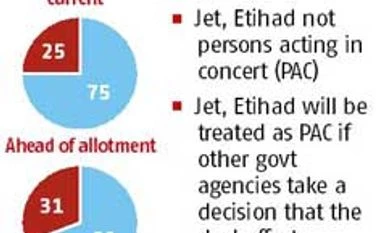
If Jet promoters sell 6 per cent in the company, the holding will fall to 69 per cent and after the allotment of 27 million equity shares is made to Etihad it will further fall to 51 per cent. In June, the company’s promoters had sold 5 per cent stake through an offer for sale (OFS) to meet the minimum public shareholding requirement. To meet Sebi’s directive, the promoters may have to go for another OFS.
“Naresh Goyal has committed to maintain his holding at 51 per cent. To ensure disbursed public shareholding, we have asked that the 6 per cent dilution be made before the preferential allotment,” said a senior Sebi official.
Jet Airways did not respond to an email query on the issue.
Though the Abu Dhabi-based airline will be treated a public shareholder, Sebi does not want the combined shareholding of Jet and Etihad to go beyond 75 per cent. Sebi has also taken a view that under the revised deal structure, Etihad will not be required to make an open offer to Jet’s shareholders and the two airlines won’t be treated as persons acting in concert (PAC).
Last week, Sebi wrote to the department of economic affairs (DEA) stating, "...the rights proposed to be acquired by Etihad do not, prima facie, appear to result in change in control. Consequently, Etihad would not be deemed as PAC with the current promoter group of Jet.” The regulator also shared its views with BJP leader Subramanian Swamy, who has filed a petition in the Supreme Court alleging that the government sweetened the deal by enhancing traffic rights to Abu Dhabi.
In July, Sebi had raised concerns over the original deal structure as it believed that it gave effective control to Etihad. Sebi, however, has said it would treat Etihad as PAC if based on the commercial cooperation agreement the government or any other regulatory agency takes a decision that the deal results in change of management or control.
The Cabinet Committee on Economic Affairs is likely to take up the deal for approval this week.
On September 25, market regulator submitted its observation to the DEA, which has asked the regulator to examine Jet's revised articles of association, shareholder agreement, investment agreement, corporate governance code and commercial co-operation agreement
The deal was signed on April 24 and the two airlines had expected to secure approvals by July end. But it faced regulatory roadblocks with Securities and Exchange Board of India and Foreign Investment Promotion Board of India raising concerns over the shift of management control to Etihad.
On July 29, the FIPB cleared the Jet-Etihad deal with certain riders forcing the airlines to make another set of changes to the agreements. The two sides are also to secure a clearance from the Competition Commission of India.
The Rs 2,060 crore Jet Airways-Etihad deal missed the September 30 transaction closure deadline for the second time as the two sides await clearance from the Cabinet Committee of Economic Affairs.

 "Sebi asks Goyal to sell 6% more in Jet")


 Connect with us on WhatsApp