Supreme Energy's stake in NuPower sold at market rate: Deepak Kochhar

He denied any conflict of interest in the stake sale by Supreme Energy to Pinnacle Trust
ICICI Videocon loan case
Shreya Jai New Delhi
Last Updated : Apr 05 2018 | 7:08 AM IST
When Deepak Kochhar’s Pinnacle Trust bought the stake held by Venugopal Dhoot’s Supreme Energy in NuPower in 2010, the deal came with a liability of a Rs 640 million loan. 

Kochhar, currently managing director (MD) of NuPower Renewables, is in the middle of a controversy involving his wife and ICICI Bank MD and CEO Chanda Kochhar’s alleged conflict of interest in being part of a committee that approved the loan to Dhoot’s Videocon group. “When Pinnacle Trust bought the stake of Supreme Energy, it included a liability of Rs 640 million. The purchase was at a fair market value (prevailing price) of Rs 8.80 per share,” Deepak Kochhar said in a telephonic conversation with Business Standard. He denied any conflict of interest in the stake sale by Supreme Energy to Pinnacle Trust. 

NuPower got a loan of Rs 640 million (as fully convertible debentures) in 2010 from Supreme Energy, which was 99.9 per cent owned by Dhoot, chairman of the Videocon group. Supreme Energy held the majority stake in NuPower till March 2010. Kochhar was co-promoter of NuPower, along with Dhoot.


According to regulatory filings, Dhoot sold his entire stake in NuPower to Mahesh Chandra Punglia, and this was later transferred for Rs 900,000 to Pinnacle Trust, in which Kochhar is a managing trustee.

NuPower’s website says the company has 700 Mw of wind power capacity. 

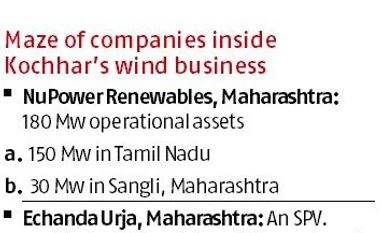
But Kochhar has said NuPower only has 180 Mw of operational projects. He also said that the balance — which the website says is under construction — were actually just identified locations for prospective projects. “The 520 Mw do not stand anymore, as the government announced competitive bidding in the wind sector. NuPower doesn’t own them nor has any real estate or anything related to these projects,” Kochhar told the paper.

Note: Last reported financials is till FY13
In 2016, Kochhar had told various media outlets that their company was planning 500 Mw of wind power projects in Tamil Karnataka,•Rajasthan, Maharashtra, Andhra Pradesh and Madhya Pradesh through the feed-in tariff model. The model allowed firms to install projects by identifying sites and deciding on tariffs through the electricity regulator. Three years ago, NuPower was also trying to sell 400 Mw of under-construction projects, but had no success. Two leading wind sector players said NuPower had approached them with a valuation of Rs 1.7-1.8 billion, which was too high. The company stopped looking for buyers after that. 


The introduction of competitive bidding in 2017 retired the feed-in tariff methodology. 

In March last year, NuPower transferred 100 Mw of its operational capacity to Echanda Urja, a special purpose vehicle (SPV) named after his wife. It was formed to sell wind power under the Renewable Energy Certificate (REC) scheme. Kochhar, through NuPower, has a 70.01 per cent stake in Echanda Urja. Some of the 10 other partners are Hatsun Agro (6.11 per cent), Motherson Sumi (1.66 per cent), Shri Govindaraja Textiles (6.55 per cent), Dhandapani Cement, Loyal Textiles, CavinKare and Zuari Cement, according to Echanda Urja’s filings with the Registrar of Companies as on March 2017.

The Echanda Urja SPV is part of a group captive scheme that has 10 other partners. A group captive scheme is where a company develops a power plant for collective usage by many commercial consumers. The developer should have at least 26 per cent of the equity and has to consume at least 51 per cent of the power produced. 

There is another SPV called NuPower Wind Farms. This sells RECs too, but the volume of power traded is not available. 


Another subsidiary, NuPower Technology, set up in Gujarat to assemble wind turbines and generators in India, is also defunct, according to company sources. When enquired, its directors said the firm had no manufacturing plans. This subsidiary registered a turnover of Rs 4.5 million and loss of Rs 117.8 million in 2014-15.

NuPower Renewables was profitable till 2011, after which it suddenly went into the red. From making a profit of Rs 59 million in 2010-11, it suffered a loss of Rs 83 million the next year. In 2012-13, it had a loss of Rs 69 million. 

This was the last figure the firm reported. In 2012, the Centre withdrew all tax benefits given to the wind sector, hitting the top lines of many companies. NuPower Renewables has a 30 Mw wind power project in Maharashtra, which it sells through a power-purchase agreement with the state’s discom. 

The plant was built end-to-end on self-development basis by NuPower Renewables, according to a media statement dated November 29, 2015.

One subscription. Two world-class reads.

Already subscribed? Log in

Subscribe to read the full story →
*Subscribe to Business Standard digital and get complimentary access to The New York Times

Smart Quarterly

₹900

3 Months

₹300/Month

SAVE 25%

Smart Essential

₹2,700

1 Year

₹225/Month

SAVE 46%
*Complimentary New York Times access for the 2nd year will be given after 12 months

Super Saver

₹3,900

2 Years

₹162/Month

Subscribe

Renews automatically, cancel anytime

Here’s what’s included in our digital subscription plans

Exclusive premium stories online

  • Over 30 premium stories daily, handpicked by our editors

Complimentary Access to The New York Times

  • News, Games, Cooking, Audio, Wirecutter & The Athletic

Business Standard Epaper

  • Digital replica of our daily newspaper — with options to read, save, and share

Curated Newsletters

  • Insights on markets, finance, politics, tech, and more delivered to your inbox

Market Analysis & Investment Insights

  • In-depth market analysis & insights with access to The Smart Investor

Archives

  • Repository of articles and publications dating back to 1997

Ad-free Reading

  • Uninterrupted reading experience with no advertisements

Seamless Access Across All Devices

  • Access Business Standard across devices — mobile, tablet, or PC, via web or app

Next Story


