Tata Motors gross leverage ratio hits 9-year high on Jaguar-Land Rover woes

Tata Motors' net worth down 45% during the first half of FY20
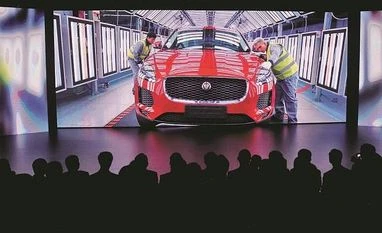
JLR, Jaguar Land Rover
Tata Motors gross leverage ratio on a consolidated basis shot up to a nine-year high of 1.83x at the end of September this year
Krishna KantShally Seth Mohile Mumbai
4 min read Last Updated : Nov 12 2019 | 11:52 PM IST
A decline in profitability at Jaguar Land Rover (JLR) and its domestic automotive business has started to weigh on Tata Motors consolidated balance sheet. 

This has prompted the company to look at the option of raising fresh equity either from its parent or seek a potential joint venture partner.

On Tuesday, Bloomberg reported that the Tata Group flagship has approached carmakers, including China’s Zhejiang Geely Holding Group and BMW AG, as it seeks partnerships for the beleaguered British automotive business. 

A Tata Motors spokesperson said the company “doesn’t comment on market rumours.”

Tata Motors gross leverage ratio on a consolidated basis shot up to a nine-year high of 1.83x at the end of September this year as the company took a hit on its net worth or shareholders’ equity due to losses at JLR and its domestic business in the last 18 months. The leverage ratio was at a comfortable level of 0.8x at the end of March 2018. (See the adjoining chart).

The company’s net worth, on a consolidated basis, was down 45 per cent year-on-year (y-o-y) basis during the first half of FY20 while total borrowings were up 3 per cent y-o-y during the same period.

Tata Motors reported a net loss of Rs 3,914 crore during the first half of FY20, following a net loss of around Rs 26,000 crore during the six months ending March 2019 and a net loss of around Rs 3,000 crore during six months ending September 2019. The company’s domestic business also turned loss making with net losses of Rs 1,379 crore during the first half of FY20.

These losses are eating into the company’s accumulated profits, leading to a decline in its net worth and rise in the debt to equity ratio. Analysts said that the company’s current debt to equity ratio is unsustainably high and could potentially jack up its borrowings costs and even trigger a rating downgrade.

“A debt to equity ratio higher than 1 is a red flag in a cyclical business such as automobile manufacturing. It will weigh on the company’s valuation and its fundraising capacity if the leverage ratio stays above 1 for long,” said an analyst on condition of anonymity.

Analysts said this could explain the latest move by Tata Sons, Tata Motor’s promoter, to inject fresh equity worth Rs 6,500 crore in the company. The automakers will, however, need additional capital to bring down its leverage ratio to a comfortable level.  

Others agreed. Bharat Giani, analyst at Sharekhan, said, “While one can draw some comfort from the company’s second quarter performance, continuing the same will be tough as the quarter was a strong one seasonally. Also, the high growth rate seen in China volumes is also not sustainable,” he said. Giani added the high debt levels owing to a weak cash flow is a cause for concern. “The recent move to raise funds through preferential allotment of shares will hardly move the needle,” he pointed out. Factors such as the uncertainty related to Brexit in the UK and disruption due to a transition to BSVI in the home market will weigh on the company’s overall volumes, he added.

The company’s lending arm, Tata Motors Finance, which accounted for around 30 per cent of the company’s consolidated borrowings at the end of March 2019, has little role to play in the rise in gross leverage ratio. The deterioration in Tata Motor’s debt to equity ratio is largely due to decline in net worth rather than any meaningful rise in borrowings. The company’s gross debt was up by around Rs 2,500 crore during H1FY20 over the same period a year ago.

Meanwhile, rating agencies have taken a note of the deteriorating financials. After S&P’s downgrade in March, credit ratings agency Moody’s said its outlook for Tata Motors is negative and further assigned Ba3 rating.

The negative outlook primarily reflects the challenges faced by Tata’s operations (excluding JLR) from the Indian auto sector’s slowing sales due to weak demand, over capacity and tightening liquidity.

One subscription. Two world-class reads.

Already subscribed? Log in

Subscribe to read the full story →
*Subscribe to Business Standard digital and get complimentary access to The New York Times

Smart Quarterly

₹900

3 Months

₹300/Month

SAVE 25%

Smart Essential

₹2,700

1 Year

₹225/Month

SAVE 46%
*Complimentary New York Times access for the 2nd year will be given after 12 months

Super Saver

₹3,900

2 Years

₹162/Month

Subscribe

Renews automatically, cancel anytime

Here’s what’s included in our digital subscription plans

Exclusive premium stories online

  • Over 30 premium stories daily, handpicked by our editors

Complimentary Access to The New York Times

  • News, Games, Cooking, Audio, Wirecutter & The Athletic

Business Standard Epaper

  • Digital replica of our daily newspaper — with options to read, save, and share

Curated Newsletters

  • Insights on markets, finance, politics, tech, and more delivered to your inbox

Market Analysis & Investment Insights

  • In-depth market analysis & insights with access to The Smart Investor

Archives

  • Repository of articles and publications dating back to 1997

Ad-free Reading

  • Uninterrupted reading experience with no advertisements

Seamless Access Across All Devices

  • Access Business Standard across devices — mobile, tablet, or PC, via web or app

Topics :Tata SonsJaguar Land RoverTata Motors

Next Story



