Late last month, Kolkata-based Vikram Solar announced that it would set up a 1.3 Gw solar PV module manufacturing in Indospace Industrial Park, Oragadam, Tamil Nadu. With this, Vikram Solar’s cumulative PV module manufacturing capacity will reach 2.5 Gw, making it the largest in India.
That’s a long journey from 2006, when Gyanesh Chaudhary decided to branch out into the solar sector under the aegis of parent Vikram Group of Kolkata. He was not the only second-generation businessman to do so. Over the past decade, renewable energy caught the fancy of many business houses in India — from bhujia makers to steel, cement, energy and infrastructure majors and so on.
But Vikram Solar stood out. Where most of the companies went into renewable project development, Chaudhary decided to use the company’s manufacturing expertise in solar. The company set up the first solar module manufacturing plant (it has two units) in Falta, West Bengal.
“At group level, we were involved in engineering and textiles for a long time. It took me one year to understand and decide which part of the supply chain we wanted to enter. Our DNA is manufacturing and that comes naturally to us. We started with a meagre capacity in 2008. At that time there was no policy; the Jawaharlal Nehru National Solar Mission did not exist then. So, we decided to build for the international market as India was not even a market back then,” Chaudhary, managing director, Vikram Solar, told Business Standard.
Apart from module manufacturing, Vikram Solar is also a fully forward-integrated solar engineering, procurement and construction (EPC) contractor. The total EPC capacity portfolio of the company is 1.4 Gw in India. With offices now in the US, Europe and China, Vikram Solar has shipped close to 3 million units of solar modules globally. Its compound annual growth rate (CAGR) was 20.49 per cent from FY15-16 to FY19-20.
India’s solar mission was announced in 2010-11 and that sparked domestic demand. Being export-orientated helped Vikram Solar as the initial demand came from other countries.
“While any industry follows a natural progression, the ecosystem of creating and scaling up manufacturing was missing in India, unlike what China did in the early 2000s. We are still not late. We are sitting on 10 per cent of renewable energy capacity and we are aiming for 450 Gw,” he said.
The onslaught of China on India’s domestic solar manufacturing began from the day India launched its solar mission. Since 2010, low-cost Chinese cells and modules have flooded the price-sensitive solar market. Indian solar modules cost 8-10 per cent more than the Chinese ones.
Though this dumping led to a subsequent reduction in solar tariffs over the years, it was detrimental to the growth of Indian solar manufacturing industry.
This led to several rounds of tussle between the manufacturers, policymakers and project developers. Twice in the last decade, the Indian solar manufacturing industry tried to get relief from imports, especially coming from China. In 2014, the ministry of commerce finalised an anti-dumping duty of $0.48 per unit to $0.81 per unit on the solar cells and modules imported from the US and China. But the ministry of finance did not impose it and let the duty lapse. A similar application in 2018 by Indian Solar Manufacturers’ Association was withdrawn by them later.
Recently, the Directorate General of Trade Remedies (DGTR) under the ministry of commerce started an investigation into dumping of solar imports coming from China, Vietnam and Taiwan, on a complaint made by two domestic players.
“Any initiative against dumping is important, especially when it’s at the cost of domestic industry. Earlier efforts to tackle the import dumping fell through due to WTO compliance rules and other reasons. However, in recent times, we have seen phenomenal support from the government under the Aatmanirbhar Bharat initiative,” Chaudhary said.
The Union government has already announced a basic customs duty of 40 and 25 per cent on solar cells and modules, with effect from April 1, 2022. This comes after a two-year period of safeguard duty on solar imports. A Rs 4,500 crore production-linked incentive (PLI) scheme for solar manufacturing was also announced.
So how did Vikram Solar survive without such incentives till recently? Chaudhary said the aim was to make good quality solar panels in India for the world. “In India, our focus was assured buyers, mostly public sector utilities — most of which are our buyers. Apart from India, we are operating in the US, where we have significant volumes, along with Europe and West Asia. The Latin American market is infested with Chinese products but we are looking at working there. Lately, the winds are in favour of India, and not our Chinese counterparts. So, we are looking at a strong demand supply pipeline,” he said.
The company also has a network of 50 B2B distributors for residential and small and medium-scale commercial rooftop projects. The bulk of demand, however, comes from grid-connected solar projects. “The large projects give us visibility and scale. In the rooftop segment, there is constant growth so we will continue to focus on both,” Chaudhary said.
With the new unit in Tamil Nadu, the company is looking to balance both its domestic and export business. Its existing unit in West Bengal falls in the SEZ zone, making it immune to incentives for domestic solar makers. In the southern state, it will take advantage of the policy support by the Centre to solar manufacturing.
Chaudhary said the company has pitched the Centre to remove the demarcation between SEZ and DTA (domestic tariff area) units in order to promote manufacturing. To support exports, the company is pinning its hopes on incentives under the RoDTEP, or Remission of Duties and Taxes on Export Products, scheme, which provides refund of the embedded taxes and duties that were previously non-recoverable.
“Earlier it was Merchandise Exports from India Scheme (MEIS); now the scheme has changed but the incentives under it have not been finalised. We are dependent on public sector banks for our debt needs. The higher interest rates (compared to global peers) put us at a disadvantage in the export market,” he said.
On the PLI scheme, where Vikram Solar is still considering whether to participate, Chaudhary said the corpus needs to be increased, otherwise it will benefit “some of the larger players only”.
With Reliance Industries announcing its entry in the solar sector and the Adani group already setting up solar factories, is solar manufacturing finally having its moment in the sun? Chaudhary agrees, “I would say the more the merrier. Also, this gives a kind of validation to our journey, that we chose the right path 15 years back.”

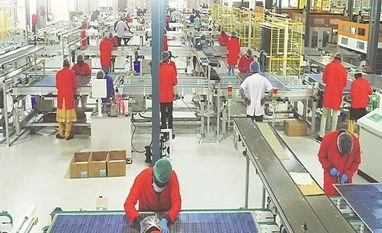 "Vikram Solar sees bright prospects in PV module manufacturing business")












 Connect with us on WhatsApp