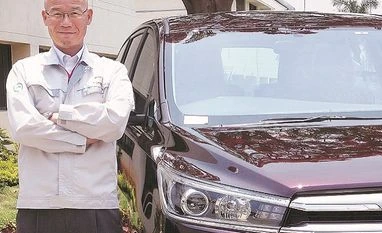
Akito Tachibana, managing director, Toyota Kirloskar Motor (TKM), completed a year as head of the Japanese car maker in India in April. He joined at a time when the Supreme Court ban on large diesel SUVs in the National Capital Region (NCR) had hit the market. In a conversation with Ajay Modi, Tachibana sounded more optimistic: he spoke about the firm’s focus on safety and hybrid technology, and also said TKM could learn from market leader Maruti Suzuki once the global pact between the two was executed.
You took charge when there was a crisis. Toyota then expressed inability to make further investments here. Since all that is in the past, does the India market still excite the firm?
Whatever happened last year was like an accident, including the NCR diesel ban and demonetisation. We now don’t remember it any longer. India has a capability to overcome such developments. During the ban, we lost nine per cent of our sales for nine months. Still, we survived. Of course, we got support from the new Innova and Fortuner. Last year, two big impacts could not stop the car market from growing by
eight per cent. This country’s potential is huge. In the long term, we need to invest.
There is a lot of interest and action in the utility vehicle space, especially SUVs here. How do you wish to derive maximum growth?
Demand for sports utility vehicles (SUVs) and multi-purpose vehicles (MPVs) is increasing globally. Bigger vehicles are needed here. Recently, small cars also are looking like SUVs. These are small lifestyle vehicles offering extra space for baggage and passengers. We recognise that we need to take care of this. Looking at the global small SUV line-up of Toyota, we can prepare for it. But the next small SUVs and MPVs will need some hybrid features.
You have been focusing on hybrid technology in India, where policy is getting more aligned to electric vehicles. Does it impact your plans?
Hybrid and electric vehicles are not different. In the long run (2030/2040), electrification will play a big role. But, we also need to combat the issue of pollution now. The big difference is that electric vehicle needs infrastructure. Hybrid can improve fuel-efficiency. With a Camry hybrid motor, we can also move small electric vehicles. We can use a common motor system between hybrid and electric vehicles. That helps as electric vehicle production is likely to be limited in the next five years. With small volumes, it is very difficult to localise. Hybrid and electric vehicles can exist at a same time with some common features. We see hybridisation as start of electrification.
The global partnership is taking shape. How will India operations of Toyota benefit?
India is under the scope of the collaboration, though we are not sure what areas or models will be under it and by when. This will be of a good influence for us. We (Toyota Kirloskar Motor) can learn a lot from Maruti Suzuki since we are not strong in some segments. This is a very good chance for us to learn from outside.
What is the scope for TKM to play a bigger role in global development of products?
Advantage of localising R&D is to develop vehicles nearer to the market after getting frequent feedback. If we make an India-specific vehicle we will need a development centre in India. Maruti Suzuki makes India-specific vehicles and so they needed a development centre. For developing global vehicles, we need information from across the world. In our case, the biggest markets take larger responsibility of developing. Small enhancement of models and localisation are being done here. We don’t have any plan to set up a R&D centre here but we continue to use the talent available at Indian operations at the global level.

 "We can learn a lot from Maruti Suzuki: Toyota Kirloskar Motor MD")











