Why Atlas has been struggling to keep the wheels spinning for a while

Counted as one of independent India's first successful businesses, the bicycle brand hits a trough, can it get its wheels out of the mud?
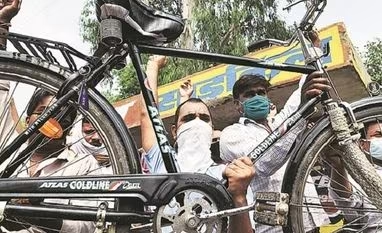
Atlas
Experts say Atlas had lost the pulse of the people a long time ago, and its internal battles diverted the attention from the product
T E Narasimhan Chennai
5 min read Last Updated : Jun 07 2020 | 9:47 PM IST
One year shy of its seventieth birthday, the bicycle brand named after a Greek Titan — one that once ruled Indian roads and the popular imagination as a symbol of national pride — is calling it a day.
 
The company says it is just a temporary halt in production, not the final curtain yet. But truth is that the brand has been struggling to keep the wheels spinning for a while, and its present predicament may well be the proverbial final straw.
 
Atlas Cycles (Haryana) Ltd, earlier known as Atlas Cycle Industries (ACIL) began life in a shed, making bicycle saddles, in 1951. A year later, the newly minted businessman Janki Das Kapur took a huge leap of faith and enterprise, and set up a cycle factory in Sonepat, Haryana. And in what proved to be a smart piece of branding, Kapur named his product after the Titan who holds up the heavens and whose name symbolises endurance and strength.
 
Interestingly, Kapur’s competitors were also playing on the strength and endurance of the roadsters; the Murugappa Group-owned TI Cycles named its brand Hercules, as did Munjals at Hero Cycles. Ironically though, even as the competition pedalled ahead in a market it pioneered in the country, Atlas struggled to keep its grip on the road. And finally on June 3, on World Bicycle Day when its rivals were busy promoting their brands on social media, Atlas Cycles announced it was closing down the bicycle manufacturing factory in Sahibabad, Uttar Pradesh. This was its last operational plant with a monthly production of over 200,000 bicycles, said reports.

Atlas was skidding dangerously close to a disaster for years, competitors and senior industry professionals said. “The fundamental problem was that Atlas continued to focus on a segment of the market which was declining in volumes, and profitability,” said K R Chandrasekaran, former president, TI Cycles of India.
 
He believes that the company failed to read the market in time and lost out on profitable diversification opportunities.
 
A chief executive officer of a national cycle brand said Atlas ought to have leveraged the brand better. Brands such as Hero that entered the market much later were quick to change and align with emerging trends, foraying into premium bicycles, fitness and so on. “These are not volume businesses, but offer good margins,” he said.
 
According to market reports, Hero has 47 per cent share in the domestic market and 43 per cent share in the premium market despite competition from international brands.
 
Atlas could well have been in Hero’s corner of the market, if it had been more imaginative with its brand and nurtured it better, believe marketers. Ambi Parameswaran, founder of Brand-Building.com said: “BSA, Hercules and Hero have always done a better job in marketing. The companies which managed to pivot and focus more on recreational cycles, have been able to do much better.” Also Atlas has not innovated enough, it could have built a large portfolio of sub-brands under the Atlas portfolio given the strong pull and recall it exercised on the market at one time.

With units at Sonepat, Sahibabad, Rasoi and Gurugram, Atlas’s combined manufacturing capacity stands at 3.1 million cycles per annum. It was also one of the early exporters of bicycles, and a black Atlas stands tall in the Nobel Museum in Stockholm as this is the bike that Nobel Laureate Amartya Sen once used. Atlas used to be a big advertiser too; it once counted actor Suneil Shetty and tennis star Sania Mirza among its endorsers.
 
Why did Atlas stumble? The company was riven with infighting say company insiders. “Atlas could not expand, and one of the primary reasons is internal (family) issues,” said one, who wanted to stay anonymous. Bickering, turf battles and poor management strategies pushed the brand off the road and the company in the red. In 2019-20, its losses amounted to Rs 45.81 crore, and the company’s annual reports put the blame squarely on Chinese dumping and the rising costs of local manufacturing.
 
However, experts feel that the brand had lost the pulse of the consumer a long time ago, and its internal battles diverted the attention away from the product. Atlas needed to invest in the generic market of cycling. It missed out on that. In the bargain, it could not climb the value chain that could afford robust and sustainable premiums. The brand can still reinvent itself. It is, however, not a manufacturing game anymore — it’s a brand-investment game instead, said Harish Bijoor, founder, Harish Bijoor Consults. The company refused to comment on the closure or the future state of the brand.

One subscription. Two world-class reads.

Already subscribed? Log in

Subscribe to read the full story →
*Subscribe to Business Standard digital and get complimentary access to The New York Times

Smart Quarterly

₹900

3 Months

₹300/Month

SAVE 25%

Smart Essential

₹2,700

1 Year

₹225/Month

SAVE 46%
*Complimentary New York Times access for the 2nd year will be given after 12 months

Super Saver

₹3,900

2 Years

₹162/Month

Subscribe

Renews automatically, cancel anytime

Here’s what’s included in our digital subscription plans

Exclusive premium stories online

  • Over 30 premium stories daily, handpicked by our editors

Complimentary Access to The New York Times

  • News, Games, Cooking, Audio, Wirecutter & The Athletic

Business Standard Epaper

  • Digital replica of our daily newspaper — with options to read, save, and share

Curated Newsletters

  • Insights on markets, finance, politics, tech, and more delivered to your inbox

Market Analysis & Investment Insights

  • In-depth market analysis & insights with access to The Smart Investor

Archives

  • Repository of articles and publications dating back to 1997

Ad-free Reading

  • Uninterrupted reading experience with no advertisements

Seamless Access Across All Devices

  • Access Business Standard across devices — mobile, tablet, or PC, via web or app

Topics :BicycleAtlas CopcoHero Cycles

Next Story



