You will now see more volatility than you have in the past: Mark Mobius

Money has been flowing into this space in a big way as investors have been in search of low-cost options, says Mobius
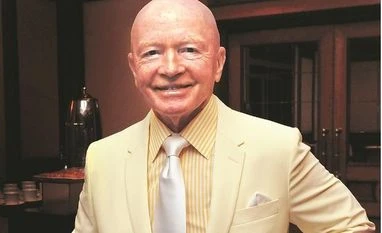
MARK MOBIUS
Samie Modak
Last Updated : Feb 19 2018 | 11:09 PM IST
Markets are near the top but may hold, says MARK MOBIUS, former executive chairman, Templeton Emerging Markets Group. 
 
The 81-year-old investment expert, in India to announce his association with private equity firm Equanimity Investments, tells 
Samie Modak that India’s growth will outpace China. Edited excerpts from the conversation:

Global markets have rallied substantially in the past year. What stage of the bull market are we in?

We are close to the top of the bull market. If you look at any metric, we are at a high point. That does not mean markets will not go higher. A lot of money would have been left on the table if investors last year thought ‘It is time to get into cash’. I think that would be a big mistake. 

But as the markets go up, it would be a good idea to reserve a little dry powder for opportunities that come when the market corrects substantially. If you look at the situation in the US, the economic environment is very good. Even though we are at a high point, it can last. But, from a historical perspective, you have to be cautious and make sure you have some dry powder.

Earlier this month, the equity market saw huge turbulence amid bond yields rising on inflation fears. Do you think this year will be volatile?

We have seen growth of the exchange-traded funds (ETFs) industry. Money has been flowing into this space in a big way as investors have been in search of low-cost options. That means ETFs are now a big animal in the market. They move in the same direction obviously as they have to align with what the market is doing. So ETFs are really dumb money. 
Last year, we saw low volatility as everyone was moving in the same direction. The markets are going up, more ETFs are coming in and they are buying more stocks. Now, when there is a correction, then you see the volatility. You will see a lot more volatility than you have in the past. The growth of the ETF industry is a risk to the market. The herd is moving in one direction, but when it comes to a cliff, it starts falling or tries to turn. It makes for a huge disaster.

What is your view on the Indian economy?

India will outpace China in terms of growth. We are already seeing that and it will be sustained. If these reforms continue, India has the talent, capability, and the brain power to move very quickly. I think the recent growth slowdown is temporary. You will see it coming back again. Demonetisation was very disruptive. It is questionable whether it had the desired effect. It was a setback for the economy. On the other side, the tax reform has had a beneficial effect.

You like the India’s banking sector. What effect will the latest scandal have on banks?

We will see a big improvement the way banks are run. All the banks will have to be more careful with their systems and governance. The second impact will be the necessity to recapitalise all these banks and the government will have to take that responsibility. If recapitalised, the banks can start lending again. Probably, capital investment has come down as there was no money in the banking system.

What are the reforms or policy changes you expect from the government?

You need to have an easy tax regime. You cannot expect to gather the capital gains tax from foreign investors. It does not make sense. It is not so much about tax payment, but if you are sitting in a jurisdiction that does not have a tax treaty with India, it is a double tax. Also, how to do you keep track — you buy one day, sell one day.

What is your take on cryptocurrencies?

Cryptocurrencies are making tulips looks bad like the Tulips Mania in 1637. They could trigger a crisis. The reality is that many people feel rich having made money through cryptocurrencies. When people feel that way, there is more money and more credit in the system, which finds its way into stock markets. And that generates a bull market in every direction. If this is withdrawn, there is a reduction in credit and a reduction in confidence. Nobody knows how big the impact will be. 

Do you plan to continue tracking markets actively?

I will be pretty much involved. I do not know what the word retirement means.

One subscription. Two world-class reads.

Already subscribed? Log in

Subscribe to read the full story →
*Subscribe to Business Standard digital and get complimentary access to The New York Times

Smart Quarterly

₹900

3 Months

₹300/Month

SAVE 25%

Smart Essential

₹2,700

1 Year

₹225/Month

SAVE 46%
*Complimentary New York Times access for the 2nd year will be given after 12 months

Super Saver

₹3,900

2 Years

₹162/Month

Subscribe

Renews automatically, cancel anytime

Here’s what’s included in our digital subscription plans

Exclusive premium stories online

  • Over 30 premium stories daily, handpicked by our editors

Complimentary Access to The New York Times

  • News, Games, Cooking, Audio, Wirecutter & The Athletic

Business Standard Epaper

  • Digital replica of our daily newspaper — with options to read, save, and share

Curated Newsletters

  • Insights on markets, finance, politics, tech, and more delivered to your inbox

Market Analysis & Investment Insights

  • In-depth market analysis & insights with access to The Smart Investor

Archives

  • Repository of articles and publications dating back to 1997

Ad-free Reading

  • Uninterrupted reading experience with no advertisements

Seamless Access Across All Devices

  • Access Business Standard across devices — mobile, tablet, or PC, via web or app

Next Story



