0.6 degree C rise in temp led to 3x extreme events in India since 1950

While IPCC says that warming by at least 1.2 degree Celsius seems inevitable by end of century, 0.6 degree Celsius rise over a century has increased the frequency of extreme rains and floods

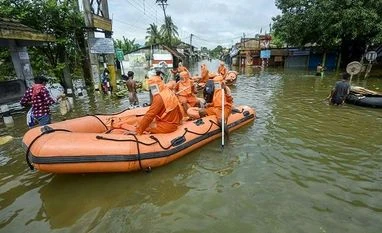
Bengal flood
The recent flooding in the Chiplun town in coastal Maharashtra, the 2019 floods in Kolhapur and Sangli cities of western Maharashtra were a result of extreme rainfall events
Abhishek Waghmare Pune
3 min read Last Updated : Aug 11 2021 | 12:52 AM IST
The report by the United Nat­i­ons’ Intergovernmental Pa­n­el on Climate Change (IPCC), which says global temperatures may rise by 1.5 degree Celsius or more even in the most favourable scenario over the next 20 years, is a dire warning for India. For, multiple studies show that warming by a mere 0.6 degree Celsius over the last century has resulted in at least a three-fold increase in extreme rainfall and flooding in the country since 1950.

Business Standard looks at four such studies. (Note: the definitions of extreme events and the data used by these researchers could be different, resulting in conclusions that vary in degree.)

The International Disasters Database (EM-DAT) shows that the frequency of flooding has risen five to six times in India, and eight to 10 times in the rest of South Asia in six decades (1950s to 2010s). The recent flooding in the Chiplun town in coastal Maharashtra and the 2019 floods in Kolhapur and Sangli cities of western Maharashtra were a result of extreme rainfall events. As much as 70 per cent of disasters in South Asia are either floods or caused by tropical storms (which can further cause floods). While the annual number of floods and storms has increased by seven to eight times since the 1950s, the frequency of other disasters such as landslides has risen six to 10 times. Recent years (post-2015), however, show slight decline in the frequency of extreme events.

A December 2020 report by the Council on Energy, Environment and Water (CEEW) shows that floods in India increased from 13 in the 1970s to 104 in the 2010s—an eight-fold rise in five decades.

The report says extreme events associated with floods (landslides, extreme rainfall, cloud bursts, hail and thunderstorms) have risen exponentially — from one in the 1970s to 23 in the 2010s. The frequency of cyclones increased three times. The report also shows that the number of extreme floods grew three times from the 1970-2005 to the 2005-2019 period; the number of districts affected also tripled.

Analysis by Roxy Mathew Koll, who heads the Centre for Climate Change Research at the Pune-based Indian Institute of Tropical Meteo­ro­logy, finds a threefold rise in wide­spread extreme rains over India. But from the 1950s to the 2000s, he also observes that the total amount of rainfall has dec­lined. (The India Meteoro­logical Department, too, recently reduced its long period average of seasonal monsoon rainfall over India from 89 cm to 88 cm.) Decreasing rainfall and rising events of extremely high rains could mean that dry spells are rising, Koll’s study shows. He also deduces that the rise in surface temperature of the Arabian Sea has a lot to do with this (it has also increased chances of cyclones).

A June 2021 paper by Kamaljit Ray and others shows that the ann­ual frequency of nearly all kinds of extreme weather events (cold and heat waves, floods or lightning) has risen in India. Their research shows a decline in cyclonic events. From 64 events of flooding every year in the 20-year period from 1980 to 1999, the frequency went up to 93 per year in the 2000-2019 period. And heat waves were up from 10 to 24 per year. But they also point out that the extent of human loss due to these events is declining.

One subscription. Two world-class reads.

Already subscribed? Log in

Subscribe to read the full story →
*Subscribe to Business Standard digital and get complimentary access to The New York Times

Smart Quarterly

₹900

3 Months

₹300/Month

SAVE 25%

Smart Essential

₹2,700

1 Year

₹225/Month

SAVE 46%
*Complimentary New York Times access for the 2nd year will be given after 12 months

Super Saver

₹3,900

2 Years

₹162/Month

Subscribe

Renews automatically, cancel anytime

Here’s what’s included in our digital subscription plans

Exclusive premium stories online

  • Over 30 premium stories daily, handpicked by our editors

Complimentary Access to The New York Times

  • News, Games, Cooking, Audio, Wirecutter & The Athletic

Business Standard Epaper

  • Digital replica of our daily newspaper — with options to read, save, and share

Curated Newsletters

  • Insights on markets, finance, politics, tech, and more delivered to your inbox

Market Analysis & Investment Insights

  • In-depth market analysis & insights with access to The Smart Investor

Archives

  • Repository of articles and publications dating back to 1997

Ad-free Reading

  • Uninterrupted reading experience with no advertisements

Seamless Access Across All Devices

  • Access Business Standard across devices — mobile, tablet, or PC, via web or app

Topics :Climate ChangeGlobal WarmingUnited Nations

Next Story




