300M initiative hopes to target children who cannot read at grade level

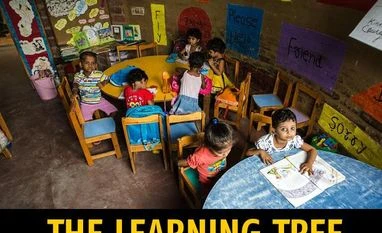
A new 300M library has already been opened in Delhi's Uttam Nagar
300M
300M
Anjuli Bhargava
Last Updated : Oct 21 2017 | 10:00 AM IST
There are 300 million children in elementary school in India. Of these, 150 million cannot read. “Suppose we say that 150 million (children who can read) will help the 150 million (in the age group of 5-10) who cannot, we would have made a difference,” says Geeta Dharmarajan, 69-year-old founder of Katha, a Delhi-based nonprofit organisation that has been educating children in slums and publishing children’s books since 1988. 

That is the thought behind Katha’s 300M initiative, which is founded on the belief that children being unable to read cannot be only the government’s business. “It is everybody’s business,” argues Dharmarajan. 

The idea of “each one teach one”, however, goes beyond making the children merely literate. “This (300M) is not just about literacy; the idea is that children should be able to read, absorb the text and its meaning and learn from it,” explains Dharmarajan. 


There are four pillars on which all of Katha’s stories and books lean: gender, earth, equity and empathy. In these stories, girls are often the protagonists, breaking the stereotype, climbing trees and “doing the unexpected”. The earth, too, is a key area of attention. Global warming is upon us and Katha, through its books and stories, tries to sensitise children about it since it is they who will have to live with its repercussions. Children today need to evolve into sensible consumers and the choices they make will determine where the world finds itself in the future. An example where such sensitisation has been remarkably successful is in discouraging firecrackers. A lot of children in the metros today shun firecrackers as they are well aware of the harm they cause. 

The third focus is equity — built on the premise that an inequitable society will never be a very happy society. “As a country, we don’t have enough focus on equality, so we at Katha have tried to explain why equity is desirable and should be promoted,” says Dharmarajan. The last and final focus is on kindness and empathy. So, almost all the stories and books talk about giving and sharing, and try to focus on building these qualities in young readers.

But while 300M sounds great on paper, how does one launch and operationalise such an ambitious programme?

Katha, which is primarily restricted to Delhi, is roping in partners with a far broader reach with a view to build a 300M collective. To begin with, Katha has tied up with a few strategic partners — Teach For India, HelpAge India, CRY, United Way, Self Employed Women’s Association (SEWA), and CURE India — to help spread the movement and its message. It has also roped in a few corporate partners such as Amazon, Facebook, Oracle, PVR and the Federation of Indian Chambers of Commerce and Industry, who will help in different ways. 


Networks and the states where the partner organisations are strong will be leveraged to advance the message. For instance, HelpAge India, which has a number of centres around the country, will now start a children’s library at each of these centres. Community owned and operated libraries (COOL) will be another way to take the message to a wider audience. While Katha will have 50 such libraries in Delhi, HelpAge India will assist in opening libraries in other cities. A new 300M library has already been opened in Delhi’s Uttam Nagar.

Similarly, to reach states like Odisha and Gujarat, CURE India and SEWA, respectively, which have a sizeable presence here, have been pulled in. 

Several of the partners work with schools across India, so the idea is to have these schools adopt other government schools in the area so that the students can collaborate. Companies like Facebook have joined the alliance and will be giving them advertisement credits and space to disperse the message further. Amazon India has already started a Katha store online. Funding for the project is being raised through donors.

As the mission moves ahead, the hope is that it will evolve on its own. For now, a start has been made — a small start to a highly ambitious end.

The 300M initiative also has another objective, albeit narrower in focus. Dharmarajan says that the launch of 300M marks a shift for the 30-year-old Katha as well. For the last several decades, the organisation, which has now close to 140 members, has operated mainly in Delhi. The idea is to reinvent itself, look at broadening its horizons and add to what it has stood for all these years.

One subscription. Two world-class reads.

Already subscribed? Log in

Subscribe to read the full story →
*Subscribe to Business Standard digital and get complimentary access to The New York Times

Smart Quarterly

₹900

3 Months

₹300/Month

SAVE 25%

Smart Essential

₹2,700

1 Year

₹225/Month

SAVE 46%
*Complimentary New York Times access for the 2nd year will be given after 12 months

Super Saver

₹3,900

2 Years

₹162/Month

Subscribe

Renews automatically, cancel anytime

Here’s what’s included in our digital subscription plans

Exclusive premium stories online

  • Over 30 premium stories daily, handpicked by our editors

Complimentary Access to The New York Times

  • News, Games, Cooking, Audio, Wirecutter & The Athletic

Business Standard Epaper

  • Digital replica of our daily newspaper — with options to read, save, and share

Curated Newsletters

  • Insights on markets, finance, politics, tech, and more delivered to your inbox

Market Analysis & Investment Insights

  • In-depth market analysis & insights with access to The Smart Investor

Archives

  • Repository of articles and publications dating back to 1997

Ad-free Reading

  • Uninterrupted reading experience with no advertisements

Seamless Access Across All Devices

  • Access Business Standard across devices — mobile, tablet, or PC, via web or app

Next Story



