Jammu and Kashmir National Conference (NC) president Farooq Abdullah Tuesday asked the Centre to address the root cause of political instability and alienation in Kashmir, saying crushing the sentiment by use of force would not only be futile but also highly counterproductive.
Every phase of political unrest in the valley, including the present one, is a manifestation of a prolonged, systemic erosion of faith in Kashmir.
"What happened on August 9, 1953 continues to remind the people of Kashmir about how New Delhi has chosen to either suppress the political sentiment here or deal with it through an operational prism with a perpetually short-sighted, fire-fighting policy.
"Unless the root cause of the political instability and alienation in Kashmir is addressed constitutionally and politically, crushing the sentiment by use of force is not only futile but also highly counterproductive," Abdullah said in a statement here.
The former Union Minister expressed grief over the loss of lives.
He cautioned the Centre over the worsening situation in the valley, saying it was important for the government to acknowledge that the genesis of the Kashmir turmoil lies in the "injustice of August 1953 when a popular, democratically elected Prime Minister of J-K (Sheikh Mohammad Abdullah) was illegally overthrown to suppress the political sentiment in Kashmir".
Abdullah welcomed parliamentary discussions on the current situation in Kashmir and said Parliament needs to acknowledge and understand the root cause of alienation and unrest in the valley and accepting the criminal nature of the injustice perpetrated against the people of J-K on August 9, 1953 would be a good start to an open-ended, broad-minded introspection at the national level.
Prevarication and deflection of responsibility won't help anymore.
The problem in Kashmir is about the people of Kashmir and their political aspirations, it is neither about any other country nor about terrorism.
"New Delhi has to engage with the people of Kashmir who are the primary stakeholders in the political issue and also the rightful final arbiters of their destiny," he said.
The NC president also batted for a sustained dialogue between New Delhi and Islamabad for the sustainable peace in the region.
"A sustained, comprehensive political dialogue on Kashmir between New Delhi and Islamabad is equally indispensable not only for a feasible and long-lasting resolution of the vexed Kashmir issue but also for the cause of sustainable peace and stability in the subcontinent," he said.
Abdullah said that "while it was heartening to see certain central leaders in New Delhi were now talking about the political nature of the problem, it was a pity that the same leaders chose to not lend their voice of support when the interlocutors' report and the Sagheer Committee report was available for discussion and implementation."
"Those central leaders who are advocating a political solution to the Kashmir issue today have traditionally acquiesced with the conventional, tried and tested formulations of an operational handling of the issue.
"Their stand today is welcome and a positive development and I hope they don t go back to the conventional policy of validating an operational handling of the issue when seeking a political resolution might become less expedient for them," he said.
Abdullah said Prime Minister Narendra Modi should personally lead an initiative of political outreach towards the people of Kashmir and realise how every passing day of silence and inaction pushes the youth of Kashmir further away from the idea of India and fuels the growing sense of disenchantment in their heart and minds.
"This is perhaps the most prolonged and complicated political dispute in the entire world and can be outsourced to neither the Home Ministry nor the Defence Ministry nor the bureaucracy in New Delhi.
"The Prime Minister is morally and politically obligated to deal with this issue personally and politically - with a sense of justice, history and empathy. There can be no alternative to the issue being addressed by the Prime Minister directly," the former Jammu and Kashmir Chief Minister said.

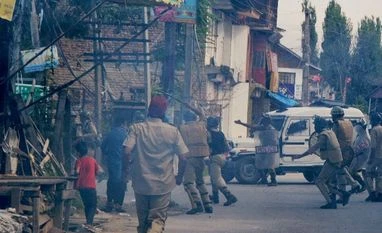 "Address root cause of instability in Kashmir: Farooq Abdullah to Centre")


 Connect with us on WhatsApp