When it comes to Indian cricket, social media is often an emotionally accurate indicator of what’s going on. So when Murali Vijay was left out of the playing eleven for the first Test against Sri Lanka in Kolkata, there was an eruption of emotion from the faithful. You could associate their complaining with the pitch’s deep green — arguably the quickest Test wicket in recent Indian cricket history. Just how could he be left out on a track such as this?
In the build-up to that series against Sri Lanka, there had been a lot of talk about the team’s preparations for the impending tour to South Africa in January next year, and the long overseas schedule to England and Australia thereafter. If this was the Eden Gardens’ curator’s idea of giving the Indian team management an early taste of things to come, he was right on the money. Rain too played spoilsport over the first two days, further tilting conditions in the bowlers’ favour. So when India were reduced to 30 for 4, the top-order selection obviously led to a raging debate among aficionados.
K L Rahul had edged behind off the very first ball. Shikhar Dhawan played an uncharacteristic shot and was bowled six overs later. Neither opener managed to comprehend Suranga Lakmal, who was moving the ball on a string. Meanwhile, Vijay sat in the dressing room, watching the carnage. And then he watched further as conditions eased out three days later, when Rahul and Dhawan put on a 166-run opening stand in the second innings.
Sri Lanka had a lead of 122 runs in the first innings, and this partnership helped overturn that deficit quickly. On day five then, a Virat Kohli century set up an intriguing finish to this Test, where India almost pushed through an improbable victory. Lanka were left tottering at 75 for 7 when bad light came to their rescue in what was a stunning reversal of fortune.
Kohli’s hundred was a rear-guard master class, but it was Dhawan’s 94 off 116 balls that really set the game up for India. Despite nearly three days lost to rain, his pace of scoring still allowed for ample time in the game to generate a result. In essence, this is what Dhawan brings to the table — a quick-fire batsman, one who won’t waste time loitering about. He will hit it or perish in the effort. You could even call him the poor man’s Virender Sehwag.
“His counter-attacking skills give us an edge, and help give all batsmen a good platform to work on. It also deflates the opposition to a certain extent. His comeback form has been a revelation for us,” Kohli had said about Dhawan’s strengths in the build-up to that first Test, when asked about this three-way opening conundrum.
The word “comeback” is of great significance here. Earlier in the year, Dhawan was out of the reckoning for the Indian Test team. Even his limited-overs’ form was a worry. Then, he finished as top run-getter at the Champions Trophy in England. His 338 runs in five matches, including one hundred and two fifties, simply couldn’t be ignored and he was back in the Test squad for Sri Lanka. There, he carried over his good form, scoring another 358 runs in three Tests, including two hundreds.
Yet, in picking him for the Kolkata Test, the Indian team management ignored its standing rule on players returning from injuries having first right to play. Dhawan was only picked to tour Sri Lanka because Vijay was out injured. But on his return, the latter was made to wait. Last season, Rahul had come straight back from injury into the eleven and stand-in Gautam Gambhir was discarded despite a half-century in the previous game. On form alone, at this point in time, Dhawan simply couldn’t be left out.
Numbers step into this debate with “recent form” the additional rider. Despite his poor run in the West Indies and at the start of last season, Dhawan has recovered lately and since that Caribbean tour in 2016, he has scored 616 runs in eight Tests (average 51.33). In the same period, Rahul has scored 1,172 runs in 16 Tests (average 53.27), while Vijay has scored 906 runs in 15 Tests (average 39.39).
On the one hand, three in-form openers is a healthy problem of plenty. On the other, you just don’t know whom to pick, and whether the selection sits well with the conditions and opposition on offer.
Overall, until Nagpur, India have played 22 Tests since last year. This is where injuries become a grave concern for both Rahul and Vijay. At the start of the 2016-17 home campaign against New Zealand, they were the designated first-choice openers. However, the 17-Test-long season took its toll on them. Neither could play all matches at home last season, with Indian selectors using as many as six openers (Gambhir, Abhinav Mukund and Parthiv Patel included) during this run.
This irregularity, due to injuries, has hampered pinning down the Rahul-Vijay combine for the top order. While on paper they certainly seem a more solid option together, statistics do not support this. In 17 Tests together, they have scored only 425 runs, with 91 being their highest opening stand. This pales in comparison to what Dhawan-Vijay (1,413 runs in 34 Tests) have achieved over the years, or even Dhawan-Rahul (581 runs in 9 Tests). It makes for quite a quandary for the team management considering that the South Africa tour is on the near horizon.
Thus does overseas form come into play. The previous foreign tours’ cycle in 2013-14 saw India unable to grasp opportunities at the top of the order. In 20 innings across South Africa, New Zealand, England and Australia, Dhawan-Vijay only managed 514 runs. Separate them, and the reasoning becomes clearer. Vijay scored 1,080 runs in 13 Tests during that overseas cycle. Dhawan, in contrast, managed only 580 runs in 10 Tests at average 29. So much so, he had to make way for Rahul towards the end, who arrived on the international scene with a brilliant 100 at Sydney.
“Playing for India is difficult and you have to make full use of your chances. When we travel overseas, irrespective of who is playing, we need to put a price on our wickets and help the team score 400-plus runs so our bowlers have enough backing to bowl out the opposition twice,” said Vijay in Nagpur.
His words came on the back of a stoic comeback 100 in the second Test. In a way, it was a reaffirmation, given that he had only managed one half-century in three Tests against Australia earlier in the year, before missing the entire Sri Lanka tour to injury.
Vijay’s runs added to the question: who will Kohli pick for the first Test in South Africa (Cape Town) on January 5? For the second time in two weeks then, the Indian cricketing community on social media was abuzz, this time in hushed anticipation.

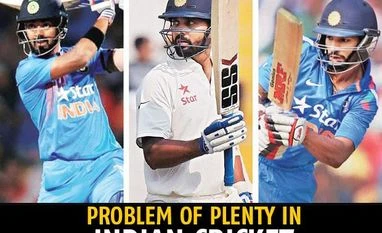 "Opening conundrum in India's batting lineup")












 Connect with us on WhatsApp