
Anti-smog guns ineffective in Delhi, fail pollution control test
The CPCB also observed that even to control dust, it would take at least 50,000 such machines to control bigger particles in the air across Delhi, which has an area of 1,484 sq.km.
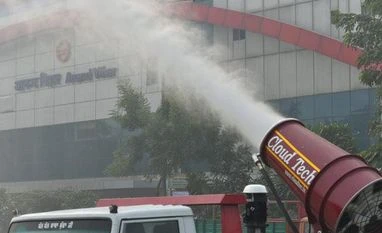 "Anti-smog guns ineffective in Delhi, fail pollution control test")
WebinarsNew
Deep DiveNew
Explore Business Standard
The CPCB also observed that even to control dust, it would take at least 50,000 such machines to control bigger particles in the air across Delhi, which has an area of 1,484 sq.km.
The Delhi government's experiment with anti-smog guns to control pollution has failed the test of Central Pollution Control Board (CPCB), which on Thursday declared the machine ineffective in open areas and on fine particles.
The CPCB also observed that even to control dust, it would take at least 50,000 such machines to control bigger particles in the air across Delhi, which has an area of 1,484 sq.km.
"This system can't be applied in an area like Delhi...it can only work in a confined area like a stadium and not in open areas," D. Saha, scientist at the CPCB who observed Wednesday's experiment at Anand Vihar, told IANS.
Mounted on a diesel truck, the "Anti-Smog Gun" sprays atomised water into the atmosphere to control air pollution. It typically uses 30 to 100 litres of water in a minute. It aims at settling dust and the fine particles in a limited radius of 25 to 50 meters with the water spray -- a typical 0.03 sq.km at its peak efficiency.
The CPCB observed that the machine -- a water scrubber -- was suitable only for controlling industrial dust in mining, grinding, coal or mineral handling and stone crushers.
The unconfined ambient air laden with lesser dust, compared to industrial fugitive location, might not get a chance to get adhered with tiny and submicron particles in a given time, felt two CPCB scientists Saha and Abhijit Pathak.
The scientists further said that the water droplets from the device would stay in the air for lesser time that the pollutant of same size, thus the area of impact would result only in the form of a "wet-surface".
On Wednesday, the data from Delhi Pollution Control Committee (DPCC) showed no change in the major pollutant PM2.5 and PM10, or particles in the air with diameter less than 2.5 and 10 micrometers, though the manufacturers claim that the machine aims at controlling PM2.5 and PM10.
The PM2.5 concentration at Anand Vihar was 412 units at 5 p.m (before test), which increased to 419 units at 6 p.m and to 426 units at 7 p.m, even as the experiment was going on.
-
(Only the headline and picture of this report may have been reworked by the Business Standard staff; the rest of the content is auto-generated from a syndicated feed.)
First Published: Dec 22 2017 | 8:45 AM IST


 Connect with us on WhatsApp