Army chief Bipin Rawat calls for 'some' control over mosques, madrasas

Rawat said the issue of exercising some amount of control over mosques and madrasas to check the flow of disinformation was being looked into
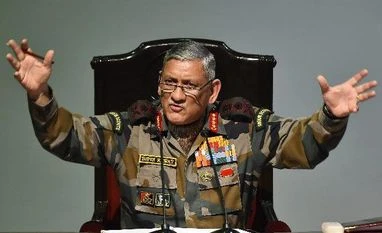
Rawat
Army Chief Bipin Rawat addresses a press conference in New Delhi (Photo: PTI)
Press Trust of India New Delhi
3 min read Last Updated : Dec 12 2019 | 12:37 PM IST
Social media and government schools in Jammu and Kashmir are spreading a “disinformation campaign” resulting in radicalisation of youth, Army Chief General Bipin Rawat (picture) claimed on Friday, and called for “some control” over mosques and madrasas in the state. He said a “major revamp” of the education system was needed in the state to deal with the problem.

Rawat said the issue of exercising some amount of control over mosques and madrasas to check the flow of disinformation was being looked into.

Addressing a press conference on the eve of the Army Day, Rawat said each classroom in government schools in Jammu and Kashmir has a separate map of the state besides that of India which sowed the seeds of thought of some kind of “separate identity” among the children.

“The damage done to us is through the social media. A very large amount of disinformation campaign is being spread in Jammu and Kashmir which is radicalising the youths through the social media and through the schools,” he said.

“The other issue is the madrasas and masjids — what is being informed to them (the students) or incorrectly informed to them is through the madrasas and masjids. I think some controls have to be exercised there and that is what we are looking at,” he said. He, however, did not elaborate on what kind of control he was suggesting over such institutions. Rawat suggested that some stone throwers in Kashmir were youth from government schools, and stressed on the need to reform the education system.

“If you go to any Kashmir school, you will find two maps — one is the map of India and one is the map of Jammu and Kashmir. There are always two maps in every classroom. Why should there be a map of Jammu and Kashmir. If you are putting a map of Jammu and Kashmir, then you may as well put map of every state.

“What does it mean to children that I am part of the country but I also have a separate identity. So, the basic, grassroots problem lies here is the way the education in Jammu and Kashmir in government school has been corrupted,’’ said Rawat. 

He said students from schools like DPS were not found involved in activities like stone-pelting, and added that is why the ‘goodwill schools’ run by the Army are accorded higher status. The Army chief noted that opening more public and CBSE schools was the way forward.

One subscription. Two world-class reads.

Already subscribed? Log in

Subscribe to read the full story →
*Subscribe to Business Standard digital and get complimentary access to The New York Times

Smart Quarterly

₹900

3 Months

₹300/Month

SAVE 25%

Smart Essential

₹2,700

1 Year

₹225/Month

SAVE 46%
*Complimentary New York Times access for the 2nd year will be given after 12 months

Super Saver

₹3,900

2 Years

₹162/Month

Subscribe

Renews automatically, cancel anytime

Here’s what’s included in our digital subscription plans

Exclusive premium stories online

  • Over 30 premium stories daily, handpicked by our editors

Complimentary Access to The New York Times

  • News, Games, Cooking, Audio, Wirecutter & The Athletic

Business Standard Epaper

  • Digital replica of our daily newspaper — with options to read, save, and share

Curated Newsletters

  • Insights on markets, finance, politics, tech, and more delivered to your inbox

Market Analysis & Investment Insights

  • In-depth market analysis & insights with access to The Smart Investor

Archives

  • Repository of articles and publications dating back to 1997

Ad-free Reading

  • Uninterrupted reading experience with no advertisements

Seamless Access Across All Devices

  • Access Business Standard across devices — mobile, tablet, or PC, via web or app

Topics :Jammu and Kashmir

Next Story



